
Learning how to start a freelance business is one of the cleanest ways to add income on military pay, and the thing that keeps most people stuck is not effort. It is three decisions, made in the wrong order.
Most people jump straight to finding clients or building a website. Then they wonder why nobody bites. The offer is blurry, the price is a guess, and every pitch sounds like “I can do a bunch of things.” That is not a client problem. That is a decision problem, and it happens before you ever talk to a single customer.
This article walks the real first moves. What you actually sell. How to niche it so a specific person recognizes it is for them. How to price it so the number holds up when someone pushes back. And the structural steps that turn a string of gigs into a business, none of which require money to start.
You have a skill, or you can build one. The question is whether you turn it into an offer someone can say yes to. Let us put the decisions in the order that actually works.
The Reason Most Freelance Businesses Stall Before They Start
Watch enough people try to start a service business and the same pattern shows up. They pick a skill they are decent at, they set up a profile somewhere, and they start pitching. Nothing lands. So they pitch harder, lower the price, add more services, and start to believe they are just not good at selling.
The stall is almost never the selling. It is that three decisions never got made.
What do you sell. Who is it for. What does it cost. When those three are clear, a pitch is short and a price is defensible. When they are blurry, every conversation turns into a negotiation about what you even do, and the person you are talking to quietly decides it is not worth the effort to figure you out.
This is not a military problem. A blurry offer stalls service businesses for commission salespeople, freelancers, agency owners, and anyone else selling their own skill. The offer that tries to be everything sells to no one. What the military reader carries on top of that is a real variable: the schedule moves, the location moves, and the income picture can shift with a set of orders. That variable is exactly why the decisions have to be clean. A legible offer keeps working when the situation changes around it, and “I do whatever you need” does not.
So we are going to make the three decisions on purpose, in order. Then the structural steps get easy, because you will know what you are building.
Decision One: Decide What You Actually Sell
Here is the step most people skip. The skill is not the offer.
Knowing QuickBooks is a skill. “I keep a small business’s books clean so tax season stops being a fire drill” is an offer. Knowing how to run Instagram ads is a skill. “I bring a local gym five new member inquiries a month” is an offer. The skill is what you can do. The offer is the outcome a client is paying to get. Clients do not buy skills. They buy the result the skill produces.
So the first decision is to translate what you can do into what someone pays for. Skill, then deliverable, then outcome. “I can do bookkeeping” becomes “I deliver a clean monthly P&L and reconciled accounts” becomes “you always know what your business made and you are never scrambling in April.” Each step gets closer to the thing the client actually wants, and the last version is the one you sell.
If you are not sure where your skill fits, use the map. Every business runs on the three business functions: Marketing, Accounting, and Operations. Marketing is visibility, content, and getting attention. Accounting is the money, the books, the pricing. Operations is the systems, the automation, the behind-the-scenes machinery that keeps a business from falling apart. Almost any sellable skill lives inside one of those three. Pick the function that matches how you already think, and you have found the lane your offer belongs in.
The offer is a decision, not a discovery.
You do not wait to find out what you are meant to sell. You choose a skill, translate it into an outcome, and commit to selling that. You can adjust later. You start by deciding, not by waiting for clarity to arrive.
Decision Two: Niche It Down Until the Offer Is Legible
This is decision two of three, and it holds up decision one: skip it, and the offer you just chose stays too broad to sell. The most common miss shows up the same way every time: the offer is too broad to grab onto. “I do social media.” “I help small businesses.” “I offer virtual assistance.” All of it invisible, because none of it lets a specific person see themselves.
Niching down feels like shrinking your market. It is the opposite. A niche makes the offer legible. It turns a vague possibility into a clear yes or no.
Compare these two. “I do social media management.” Versus “I run Instagram for local gyms so the owner never has to open Canva again.” The first one makes a gym owner think “I guess that might apply to me.” The second one makes them think “that is exactly my problem.” One is a maybe. The other is a decision. And a decision is what you want, because a maybe never books and never pays.
Stack three choices together. Pick a function. Pick a client type. Pick one outcome. Function: Marketing. Client type: local service businesses. Outcome: a steady stream of inquiries without the owner touching it. Now the offer is legible, the pitch writes itself, and the price has something to attach to.
A narrow offer is easier to sell and easier to price than a broad one, every time. The fear is that you are turning away business. Early on, you are not turning away anything, because a broad offer was not booking business in the first place. Start narrow enough that one specific person recognizes it, and widen later once you have proof and a process.
Decision Three: Price It So the Number Is Defensible
Pricing is where most people freeze. They pull a number out of the air, feel embarrassed by it, and drop it the moment a client hesitates. The fix is to stop hoping the price gets accepted and start pricing something you can defend.
You can defend a price when it is attached to an outcome instead of to your minutes. Nobody wants to pay for your hours. They want to pay for the result, and they want it to be reliable. Price the result and the reliability, not the clock.
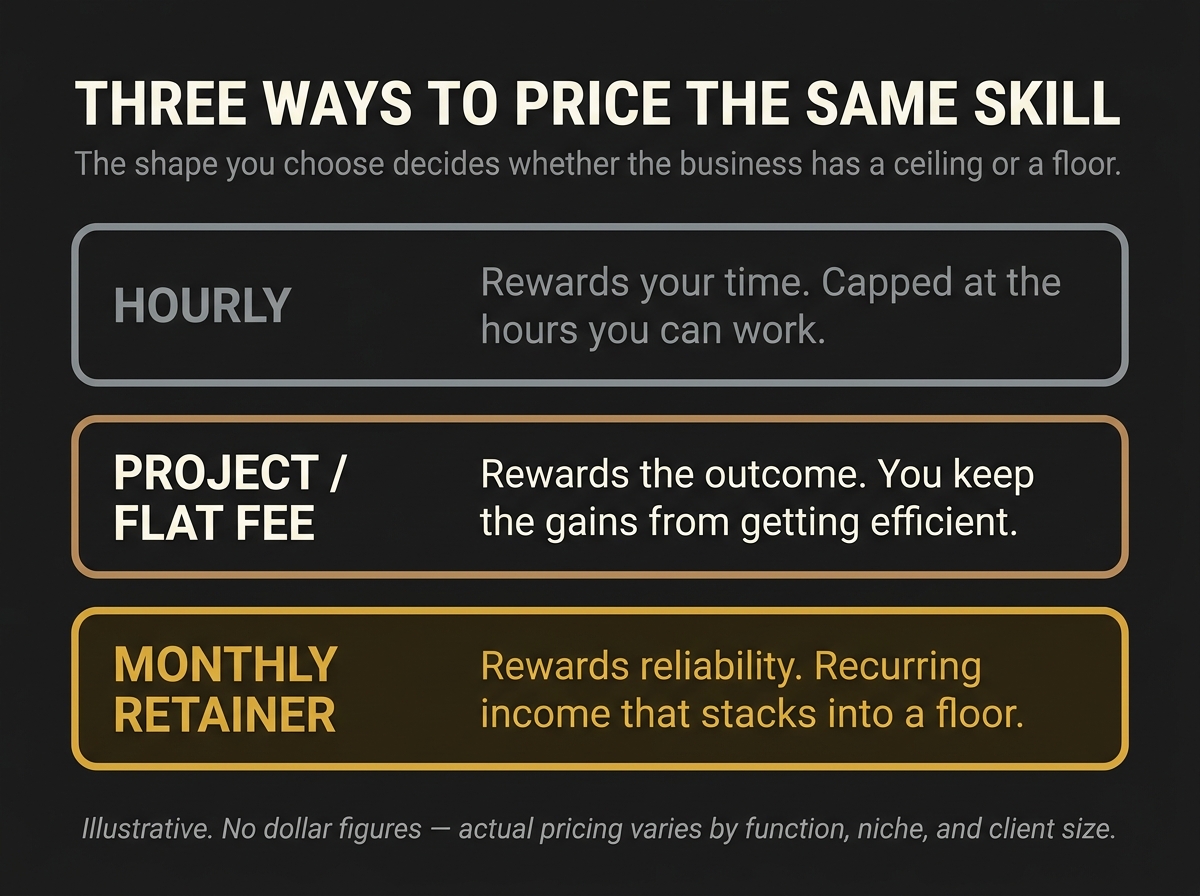
There are three shapes freelance pricing usually takes.
Hourly is the simplest to start and the worst to stay on. You trade time for money, and your income is capped at the hours you can work. On an irregular schedule, that cap is a hard wall. Useful for a first gig or two while you learn what the work really involves. Not a place to build.
Project or flat fee prices the outcome. You quote a number for a defined result, a website built, a set of accounts cleaned up, a launch managed. The client knows the total up front, and you are rewarded for getting efficient instead of getting punished for it. This is where you go the moment you understand the work well enough to scope it.
Monthly retainer is the goal for most service work. The client pays a set amount every month for an ongoing outcome, the books kept current, the ads managed, the systems maintained. Recurring, predictable, and it stacks. A handful of retainer clients is a real income floor, and entry retainers run in a range you can plan around. Actual numbers vary by function, niche, and the size of the client, so treat any figure as illustrative and price to the value you deliver.
Whatever shape you choose, do the arithmetic against your own situation. If the ceiling on military pay leaves a monthly gap, look at what a couple of retainer clients at a defensible price would do to it. Run your own numbers before you decide what to charge.
The Structural First Steps (You Do Not Need Money or an LLC to Start)
Once the offer, the niche, and the price are decided, the setup is smaller than people expect. A freelance business needs four things to function, and none of them cost anything to put in place.
A clear one-line offer you can say out loud. A way for people to reach you. A way to send an invoice and get paid. A simple written agreement on what the work includes and what it does not. That is a working service business. Everything else is optional at the start.
Here is what is not required before your first client. An LLC. A website. A logo. Paid software. A certification. Registering a business is a real step, but it is a later one. Filing fees vary by state, roughly fifty to a few hundred dollars, and none of it needs to happen before you earn a dollar. The work proves you are worth hiring faster than any credential does.
The sequence matters, and I have watched people get it backwards more than any other part of this. They set up the LLC and the logo and the accounts before they have sold a single thing, and it feels like progress. It is avoidance wearing a productive costume. Decide the offer and the price. Do the work well for the first client or two. Then formalize the structure, the LLC, the separate accounts, the tidier systems, as the income becomes steady and predictable. Deciding what you sell and selling it is the part that actually matters, so do that first. The paperwork waits.
None of this is legal or tax guidance, and when registration time comes it is worth a short conversation with someone who knows your state. But the starting truth is simple: a clear offer and the willingness to make it are the only things standing between you and your first freelance dollar.
The Function, Not Just the First Gig
One offer, sold one time, is a gig. It puts cash in your hand and then it is over. The same skill, decided on purpose and sold as a repeatable service, is a function. And the function is the business.
That is the shift from doing freelance work to running a freelance business, and it is the whole idea behind Learn It, Use It, Sell It. You learn a real business function. You use it for your own work. Then you sell it as a service to people who need it and cannot do it themselves. Every skill pays twice, once as the thing you know and once as the income it produces. The offer you just decided on is step one of that model.
If you still need to land client one, especially with no reviews and no track record yet, that is its own set of moves, and how to get your first client runs the whole play. But the destination is the model itself. Learn a function, use it, sell it, and repeat it until one decided offer becomes durable income you own. You have made the decisions that keep most people stuck. The work now is to build the offer into a function.
Build Your First Offer Alongside People Doing the Same Thing
Earning more works on two timelines, and the Millionaire Veteran community is built around both. The Cash Injection Playbook is the fast lane: one-off moves to put cash in hand quickly for momentum, debt paydown, or closing a near-term gap. The Learn It, Use It, Sell It framework is the long lane that turns a decided offer into recurring service income. Both live inside the same free community, alongside the Compass Method that routes every new dollar to a purpose instead of letting it leak into lifestyle creep. Members are building it together as they execute. Free. No pressure.

About the Author
Joshua Breaux
Retired U.S. Marine
Financial Management Analyst
BS & MBA in Analytics
His family runs on the same systems he teaches here.
This content is educational and does not constitute personalized financial advice. Millionaire Veteran is not affiliated with the Thrift Savings Plan, FRTIB, or the U.S. Government. Past performance does not guarantee future results.