

I went from making $2,400 a month as an E-4 to clearing $11,000 a month in passive income using one simple system. No experience. No startup capital. I built it during a deployment on my phone. My wife quit her job three months later.
Since then, over 300 military families have gone through the same training. Guys on deployment. Spouses running it from base housing while the kids nap. An E-6 at Lejeune hit $4,200 in his second month. A spouse at Fort Campbell replaced her entire income in six weeks. These are real people with real results, and the training comes with a 30-day money-back guarantee so there is zero risk to you. If I can do it, you can too. Comment “INFO” and I will send you the free training that changed everything. Only 50 spots left this week.
Stop.
Read those two paragraphs again, slowly.
Notice what just happened. Every sentence in that pitch was doing a specific job. The income claim matched a pay grade you would recognize. The deployment detail and the spouse quitting her job made it feel like your life. The base names made the testimonials feel local and verified even though I made them up ten minutes ago. The money-back guarantee sounded like safety, but the refund window would close months before you realized the product did not deliver. The “only 50 spots” created urgency where none existed. And “if I can do it, you can too” is the single most effective sentence in this entire industry because it takes someone else’s claimed result and pastes it onto your sense of what is possible.
None of those elements work in isolation. A money-back guarantee by itself is just good business. Testimonials by themselves are just social proof. What makes it a playbook is the combination: stack enough of these triggers in sequence and the emotional response arrives before the critical thinking has time to catch up. By the time you are analyzing the claim, you have already felt the pull. That is the design.
I wrote that pitch in thirty seconds because the template is that standardized. There are people running ads with that exact structure right now, today, targeted at military families. Thousands of them.
I used their playbook on you so you would feel it from the inside. Because once you recognize how the sequence works, you will see it everywhere.
This article is about the patterns behind those pitches, how the machine operates, and how to tell the difference between someone selling you a dream and someone teaching you a skill. The previous article showed you the income ceiling. Before you do anything to close that gap, you need to know what not to step in.
How the Machine Works
The online business education industry generates billions in annual revenue. Some of that revenue comes from legitimate educators teaching real skills. A lot of it comes from professional marketers who have figured out that selling the idea of income is more profitable than teaching people to earn it.
The difference between those two groups is not obvious from the outside. They use the same platforms. They run the same style of ads. They even use some of the same language. The difference is structural, and seeing the structure is what this article is about.
Here is what the machine looks like from the inside.
“Would You Like Fries With That?”
There are people who teach this for a living. They get on podcasts and YouTube and say things like: “The greatest sales hack of all time. I learned it at McDonald’s when I was 15. ‘Would you like fries with that?’ and ‘Would you like to supersize it?’ As soon as somebody makes a purchase, you have them. At that exact moment, you hit them with the upsell. The reason people don’t buy from you is because you’re not offering. The reason you don’t increase your sales is because you don’t upsell after the transaction is already made.”
They say this out loud. They teach it to rooms full of people. They call it the greatest hack in sales and they mean it. And thousands of online business owners listen to that advice and go build exactly what you are about to see described.
Here is what it looks like when it reaches you.
You click an ad for a $7 ebook. Why $7? Prices ending in 7 are an internet marketing convention. They signal “this was priced by a marketer” to anyone who knows the playbook and “this is a precise, intentional price” to anyone who does not. When you see $7, $27, $47, $97, you are looking at a funnel, not a product.
You buy the $7 ebook. Before you even receive it, the checkout page changes. “Wait, add this $27 toolkit to your order. One click, same transaction.” That is called an order bump. You already said yes once. You are primed to say yes again. That is the psychology, and the person who built this page learned it from someone who compared it to asking if you want fries at a drive-thru window.
Next page: “One-time offer. This $97 video training is normally $297, but because you just purchased, you can add it right now for $97. This offer disappears when you leave this page.” That is the OTO, the one-time offer. The countdown timer is fake. The page will show the same offer tomorrow. But the urgency works because you have already said yes twice and saying yes a third time feels like momentum, not spending.
Say no, and a downsell appears. “Not ready for the full training? How about just the quickstart module for $47?” They planned for your no. The downsell was built before you clicked the ad.
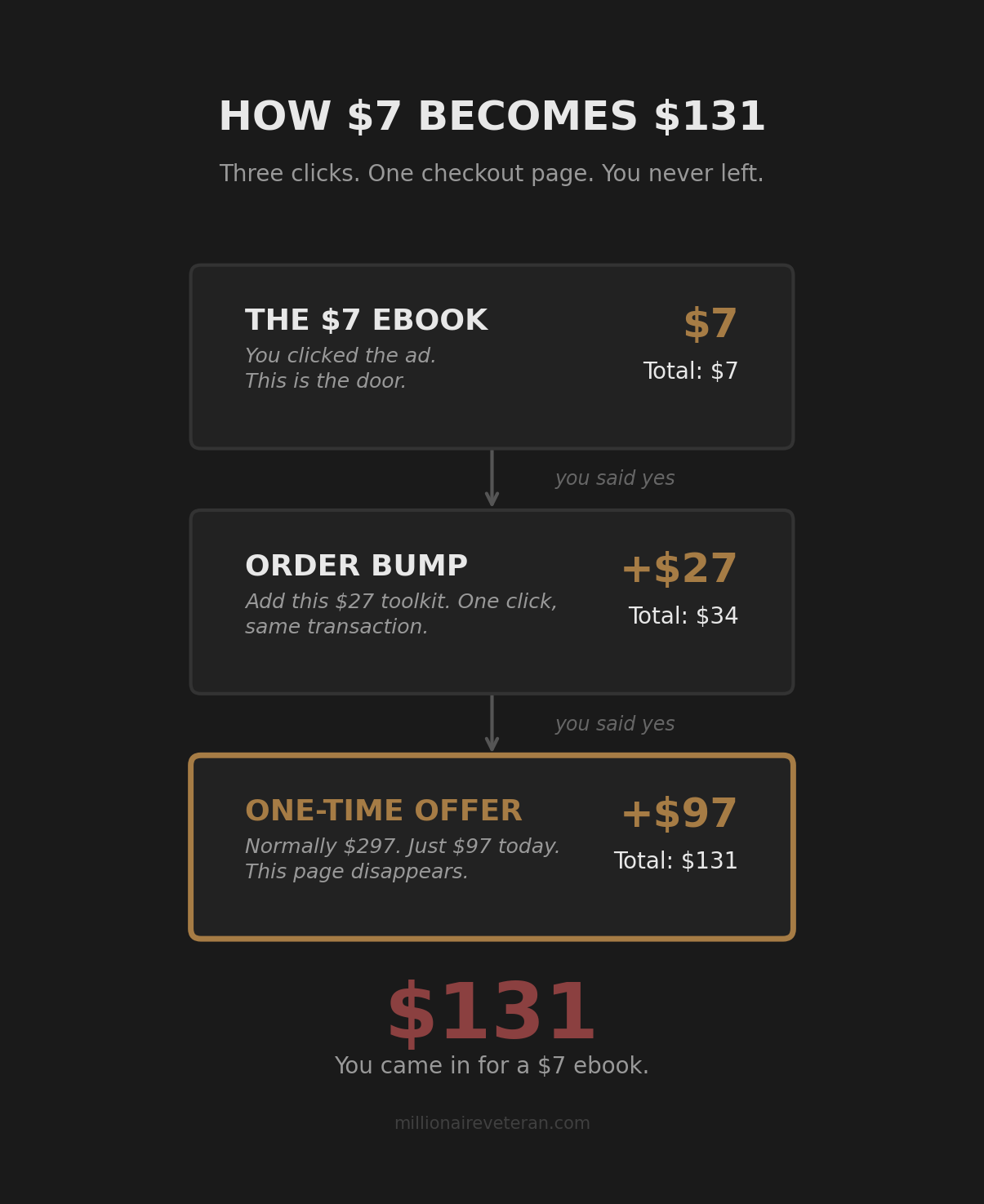
You came in for a $7 ebook. Three clicks later, without leaving the checkout flow, you have spent $131. The platforms that power these funnels have order bumps, one-time offers, and downsells built into their page editors as drag-and-drop features. The creator did not invent the sequence. They watched someone explain the McDonald’s drive-thru on a podcast and then dropped the template into their checkout page.
The concept behind “would you like fries with that” is not evil. Offering a related product at the point of sale is normal business. The problem is what happens when the person building the funnel is better at stacking offers than delivering value. When every tier exists to extract more from a single transaction rather than to solve a deeper problem. When the $7 ebook was never the product. It was the door, and every page after it was designed to increase how much you spend before you leave.
The Fake Masterclass
The second funnel is slower and more expensive.
You see an ad for a “free masterclass” or “free training.” You register with your email. The page says it starts at a specific time, maybe 15 minutes from now. A countdown timer ticks down. When it hits zero, a video plays.
The video is not live. It was recorded weeks or months ago. The chat sidebar showing other attendees asking questions? Some of those are bots. The “live” feel is manufactured by platforms designed specifically to simulate a live event. The entire thing is automated and runs on a loop, multiple times a day, every day.
The presentation follows a precise structure. Forty-five minutes to an hour of content that is genuinely useful but incomplete. Just enough to make you think “this person knows what they are talking about” without giving you enough to act on. Then the pitch.
The pitch starts with what the industry calls a “value stack.” The creator lists everything included in the offer: the core course, the bonus modules, the templates, the community access, the coaching calls. Each one gets a dollar value assigned to it. $4,997 for the course. $2,000 for the templates. $1,500 for the coaching. $997 for the community. The total is announced at $9,494 or some large, specific number.
Then the reveal. “But you are not going to pay $9,494. Today, because you showed up live,” which you did not, “the investment is just $1,997.” The price drop is designed to trigger relief. The number $1,997 feels small compared to the $9,494 that was anchored moments ago. The “valued at” numbers were never real prices anyone paid. They were invented for the stack.
A countdown timer appears. “This offer expires when the replay comes down.” The replay does not come down. If you close the tab and revisit the page tomorrow, you will get the same countdown, the same “live” event, and the same price.
These two funnels, the fries funnel and the fake masterclass, are the infrastructure that almost every guru operation runs on. They are not inherently illegal. They are not even rare. They are standard practice for an entire category of online business, and understanding their mechanics is the first step to evaluating any offer that uses them.
The Marketer-First Pattern
The fries funnel and the fake masterclass are the mechanics. But the mechanics need a product to sit on top of them. Here is where the pattern gets interesting.
The product keeps changing. The funnel never does.
In 2018, it was dropshipping. Build a Shopify store. Sell products you never touch. Passive income in 30 days. The ads showed screenshots of Shopify dashboards with $50,000 months. The courses cost $997 to $4,997. The rented Lamborghini in the thumbnail was the same one three different creators used in the same week.
By 2020, the product shifted to social media marketing agencies. Same funnel. Same lifestyle shots. Same promise: build an agency, land clients, fire your boss. The creators who had been selling dropshipping courses six months earlier were now selling SMMA courses with the same checkout pages.
Then GHL and SaaS reselling. Then short-term trading. Now, in 2025 and 2026, it is AI automation agencies. “Build an AI business.” “Use AI to replace a team of ten.” The tool is real. The pitch around it is the same dream-selling model wearing a new skin.
The creator’s actual skill is marketing. They were never good at dropshipping or agency work or AI. They are good at running ads, building funnels, producing content that converts, and selling the next thing. When one product cycle saturates, they pivot to the next trending topic and rebuild the same funnel on top of it.
The tell: if the creator has sold three different “build a business” courses in three years, each in a different industry, and every launch looks and feels the same, the marketing IS the product. The thing on top of the funnel is interchangeable.
The Rented Lifestyle
The Dubai hotel suite. The Lamborghini in the driveway. The “morning routine” filmed in a house that costs more than your BAH covers in a decade.
Most of it is rented. Production studios in Miami and Dubai rent luxury cars and mansions by the hour specifically for content shoots. Some creators have been documented offering $1,500 bounties for positive video testimonials, with winners never announced. Others have been caught filming in the same rented villa that appeared in six different creators’ content the same month.
The lifestyle imagery is not proof that the method works. It is proof that the marketing budget is large enough to rent convincing props. The viewer is supposed to think “this person is rich, so their course must work.” The actual logic is: “this person runs profitable ads for courses, so their ads look expensive.”
MLM: Same Pattern, Different Wrapper
Everything above lives online. Ads, funnels, checkout pages, fake webinars. MLM is different. It shows up in person, from someone you trust.
A spouse at your new base invites you to coffee. You just PCSed. You do not know anyone yet. She is friendly. She has kids the same age. Somewhere between the small talk and the second cup, the pitch starts. The products are real, physical things: skincare, supplements, essential oils, leggings, insurance. It does not look like the guru model because there is no Instagram ad and no checkout funnel. There is just a friend asking you to try something and then asking you to sell it too.
That personal connection is what makes MLM harder to see and harder to leave. The product-based packaging makes it feel like a real business. The in-person relationship makes saying no feel like rejecting the friendship. And the structure underneath is the same extraction model wearing different clothes.
The data from the companies themselves tells the story. The FTC analyzed 70 MLMs and found that the vast majority of participants earned under $84 per month. One of the largest companies in the industry reported that 79% of its 1.9 million distributors earned zero commissions in a typical month. Participants in MLM structures file bankruptcy at 18% compared to 11% for non-participants.
Military families are a specific target. Spouse unemployment runs around 22 to 23%. PCS moves every two to three years create isolation and a constant need to rebuild social networks. The built-in community on every base provides a ready-made recruiting pool. The stable household income from the service member means there is always money coming in to fund the “investment.” Some MLM companies actively recruit through military job boards and spouse networking events.
Military families lost $584 million to fraud in 2024. That number was up over $100 million from the previous year. Service members encounter scams at higher rates than civilians, and when they engage, they lose more on average.
If you are in one now, look at the income disclosure statement for your company. Look at what you have spent versus what you have earned. Run the math. The math will tell you everything.
Why You Have Already Been Trained to Respond
The question people ask is “why would anyone fall for this?” The answer is straightforward: because you have been trained to.
Years of scrolling past these ads, watching these videos, seeing these thumbnails has conditioned a response pattern. Bold claims feel normal. Urgency language feels familiar. Lifestyle imagery triggers aspiration before skepticism kicks in. The feeling of “this could be me” arrives before the analytical part of your brain has time to evaluate the claim.
That is not stupidity. It is pattern conditioning, and it is the result of professional marketers spending millions of dollars optimizing the exact sequence of words, images, and emotions that get people to click.
Here is the part that nobody talks about. This conditioning creates a problem for anyone legitimate trying to teach real skills. When someone shows up without the rented lifestyle, without the bold income claims, without the pressure ladder, their pitch feels underwhelming. It feels small. The audience has been trained to respond to spectacle, and substance without spectacle registers as less valuable.
So when you see a straightforward offer, no hype, real skills, honest timelines, and your first reaction is “this seems too plain,” that reaction itself is the fingerprint of the conditioning. The gurus did not just take people’s money. They recalibrated what business education is supposed to look and feel like. Recognizing that recalibration is half the battle.
The other cost is the conclusion people reach after the guru model fails them. Not “that specific thing was a scam.” Instead: “earning more does not work for people like me.” That false conclusion shuts down the entire income domain for someone who could have succeeded with real guidance and a real framework. The guru did not just take their money. They took their belief that the math could change.
You Already Knew
Think back to the last time you saw one of those ads. The income screenshot. The lifestyle shot. The “comment INFO” call to action. Something felt off. You probably scrolled past it, or maybe you clicked and then backed out halfway through the webinar registration. Either way, there was a moment where your gut said no before your brain could explain why.
Here is what your gut was reacting to.
The Lambo was rented. The “limited spots” were fake. The masterclass was pre-recorded and running on a loop. The $9,494 value stack was invented five minutes before the slide was made. The course about selling courses had no business underneath it. The friend at the coffee shop was repeating a script her upline gave her. The income claim in the ad matched your pay grade because the targeting was set to military zip codes.
That instinct was right. The only thing missing was being able to name the parts.
The next time you see a $7 offer with three upsells behind it, you will see the fries funnel. The next time someone invites you to a “free live training,” you will know it is not live. The next time a creator pivots from dropshipping to AI agencies with the same checkout page, you will recognize the marketer-first pattern. And the next time a friend at a new base invites you to coffee and the conversation turns into a pitch, you will know exactly what you are looking at.
None of this means every course is a scam or every community is a pyramid. It means you can see the machinery now. And when you can see it, you get to choose based on what is actually being offered instead of what the marketing made you feel.
What Comes Next
Seeing what is fake is half of it. The other half is seeing what is real.
The next article in this series is about what actually sits underneath every business that works. Three functions that every business runs on, whether it is a photography studio or a Fortune 500 company. Once you see the structure, the question stops being “what business should I start?” and becomes something more useful.
The Community Sees It Too
The Millionaire Veteran community is where these patterns get discussed openly. Members share what they have encountered, what is working, and what turned out to be another version of the same playbook. The community is free. Other products exist in the ecosystem, and you will see them when they are relevant to you, but the free community is complete on its own and nobody is going to pressure you into buying anything.

About the Author
Joshua Breaux
Retired U.S. Marine
Financial Management Analyst
BS & MBA in Analytics
His family runs on the same systems he teaches here.
This content is educational and does not constitute personalized financial advice. Millionaire Veteran is not affiliated with the Thrift Savings Plan, FRTIB, or the U.S. Government. Past performance does not guarantee future results.