

The money is real. It is worth having, and a spouse who spends it well walks away holding something that works in any zip code.
Almost every conversation about it stalls on the wrong question.
Search military tuition assistance for spouses and you get a wall of pages answering “how much is it?” The dollar figure is the easiest thing to publish and close to the least useful thing to know. What matters is where the money lands, and most of the pages steering that decision are written by the people selling the seat.
One terminology note first, because the search phrase itself is misleading and nobody bothers to say so. Tuition Assistance is the service member’s benefit, run by each branch for its own people. The spouse-side money is a separate program with its own rules, and it is the one this article is about.
What follows is not an application walkthrough. The official portal does that better than any blog can, and it is the only place the current terms are authoritative. This is the question underneath it: which of three business skills to point the money at, where on that skill’s path it actually changes anything, and how to tell whether you need it at all.
You Do Not Need a Degree to Start Earning
Not one dollar of your first income in any of these functions depends on a credential.
Every business runs on the three business functions, Marketing, Accounting, and Operations, plus delivery as the variable. Not one of the three has a gate on the front of it. The platforms teach their own tools because their revenue depends on people using them competently. Ad systems publish their own documentation. The accounting software runs a free certification on itself. Vendors document their own products because unused software gets cancelled. A person who wants to learn any of these functions can do it at a cost of zero dollars and some patience.
The people who buy the entry-level work are not checking for paper either. The owner handing over their social accounts wants to see what you have run and what happened when you ran it. The one handing over their books wants to know the books are safe with you. The one whose scheduling is a mess wants to see something you untangled. Demonstrated work is the currency at that level, in all three functions, and the person writing the check has almost certainly never asked to see a certificate.
So nothing about earning your first dollar in any of these functions waits on this benefit or on any other approval. The market is built that way, which is why the Azimuth Roadmap, the milestone sequence the community works through, treats learning a function as a step that starts immediately and costs nothing. It does not require capital either, which is a separate question covered in starting without capital.
This program is a tool for a decision much further along than the one most people are standing in front of when they find it.
What Military Tuition Assistance for Spouses Actually Covers
The program is officially the SpouseWorks Scholarship, and nearly everyone still calls it MyCAA, short for My Career Advancement Account. It is a Defense Department workforce program administered through the Spouse Education and Career Opportunities program at Military OneSource. Millionaire Veteran is not affiliated with, endorsed by, or authorized to speak for the Department of Defense, Military OneSource, or this program. The official portal is the only authority on current terms, and the terms change.
As of August 11, 2026, the official program pages describe up to $4,000 in financial assistance. The eligible uses are specific: a license, a certification, an associate degree, or continuing education courses to maintain a license or certification needed for employment, plus national tests that earn course credit toward an approved degree. Eligibility runs to spouses of active duty members and of National Guard and reserve members serving under qualifying Title 10 orders, and as of that same date the program describes eligibility across all ranks and pay grades. That last part is a change from a narrower band that applied in earlier years, which is exactly why the portal and not an article is where you confirm your own standing.
Read that eligible-use list again, because it defines the shape of the thing. This is not open-ended degree funding. It is capped, it is gated, and it is aimed at a credential attached to employment. Whatever you point it at has to be a credential someone recognizes, which means the question is not whether you can spend it. It is where spending it changes anything.
Where This Money Fits in the Progression
Learn It, Use It, Sell It is the model underneath all of this, and it runs in that order for a reason. Skill stacking comes first, on top of the instinct you already have. Then you use the skill on something of your own, where the stakes are yours and the mistakes are cheap. Then you sell it to businesses that need it.
The first two stages cost nothing. Learning the function is free, and practicing it on your own numbers or your own scheduling is free because you already own the system you are practicing on. There is nothing in either stage for a benefit to buy.
Sell It is where money changes hands, and it is where the path starts to have rungs. The bottom rung of every function is doing the work: producing the thing, running the thing, keeping the thing accurate. Above it the work shifts from doing to deciding, the buyer is paying for judgment instead of hours, and the rate moves accordingly.
Nothing pushes you up them. This is a roadmap with checkpoints, not an escalator, and a checkpoint is a place you are allowed to stand. Plenty of people run the bottom rung for years because the work-to-revenue ratio sits where they want it and the rest of their life is not negotiable. That is a landing spot, not a failure to advance. The runway exists whether or not you walk all of it.
If you do decide to climb, three things move you: reps, proof, and knowledge. Reps are hours in the work, free and slow and always effective. Proof is results you can point at, and it compounds. Knowledge is the distance between what the next rung asks and what you currently know how to do. This benefit reaches only the third, and only one way of closing it. Not at the start, then, and not at every climb. At a specific kind of gap, and only when paying is the right way to close it.
Marketing: From Campaigns to Strategy
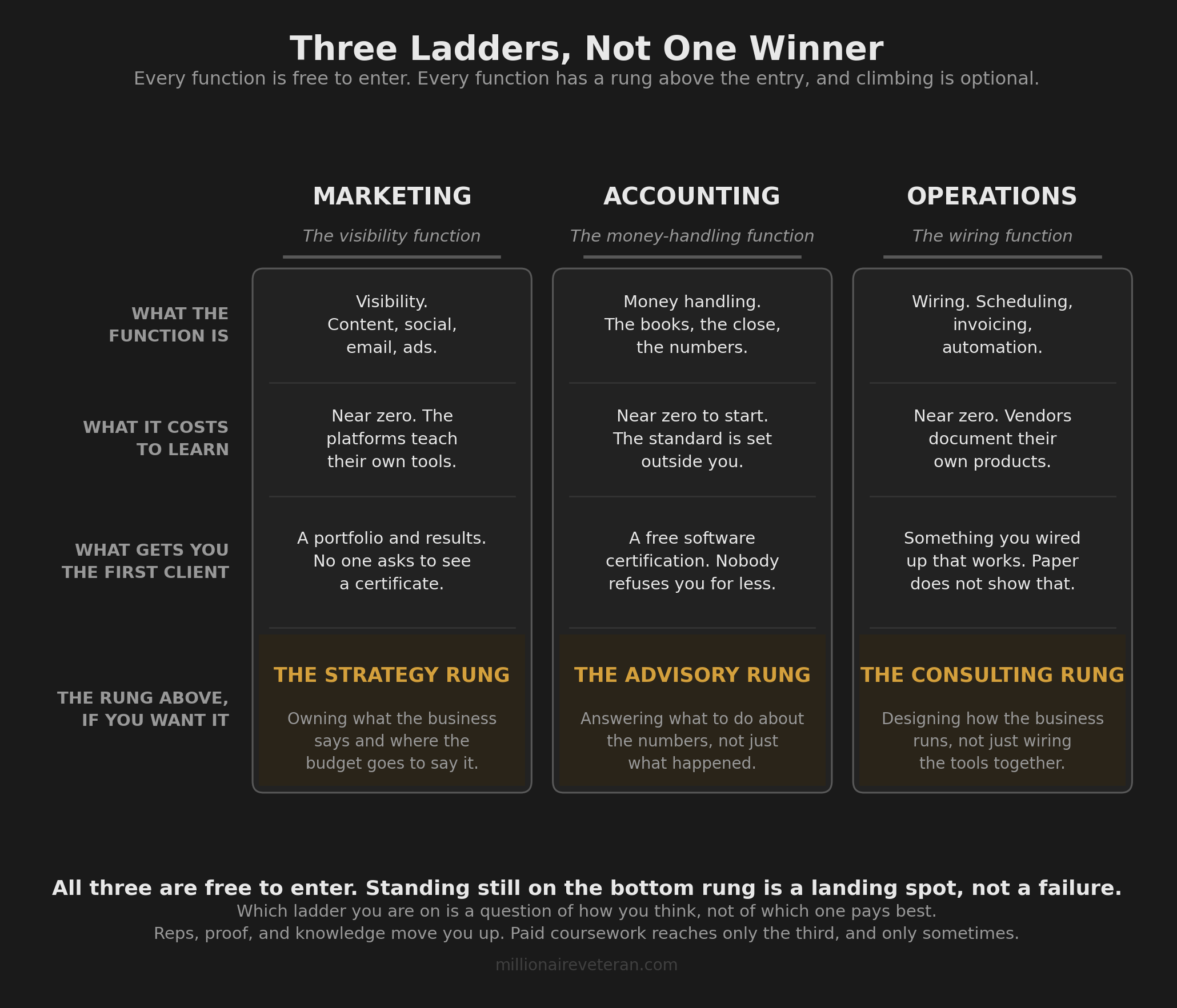
Marketing is the visibility function. Content, social accounts, email, ads, the whole job of making sure people know a business exists.
The entry rung is execution. Running the accounts, writing the posts, building the sequences, managing the spend. Buyers at this level want a portfolio and numbers that moved, and a certificate bought to win that first client buys something nobody checks. If the question underneath this is what the work is worth, that is a separate skill with its own article on what to charge, and pricing badly costs more than skipping a certificate ever will.
The rung above is strategy. Deciding what a business should say, to whom, and where the budget goes to say it. That gets bought as consulting rather than as task work, and it shows up as fractional marketing leadership, brand and positioning, growth strategy. Buyers at that level are handing over direction and money rather than a login. Nobody is checking your transcript before they do it. What formal study buys here is the vocabulary to hold the room, the frameworks to structure an answer you would otherwise improvise, and a line on your site that a certain kind of buyer reads as seriousness. Useful, sometimes decisive, never the thing standing between you and the work.
Accounting: From the Books to Advisory
Accounting is the money-handling function. What comes in, what goes out, and what it means.
The entry rung is bookkeeping, and this function has the best documented ladder of the three. The bookkeeping side hustle lays it out with the numbers attached. A free software certification is enough to start and nobody refuses you for lack of anything else. The next rung, expanded service lines like payroll and sales-tax filings, is unlocked by a year or two of doing the work rather than by buying anything.
The rung above is advisory, and it is a different job from producing the statements. Bookkeeping answers what happened. Advisory answers what to do about it: which services actually make money and which cost more to deliver than they bring in, whether the pricing covers the true cost, what the cash position will look like in a quarter, whether this is the year to hire. The owner stops calling you at month-end to review numbers and starts calling you before decisions. That gets bought as a retainer for judgment rather than for hours, and it shows up as fractional CFO and advisory work. Formal study earns its place here more than in the other two. It still is not a gate, and plenty of people reach this rung on reps and results alone.
The reason it earns that place is exposure. Handing over the books means handing over the bank feeds, the receivables, the payroll, and a complete picture of how healthy the business really is, and a buyer deciding whether you are safe with all of that is hunting for reasons to say yes. Before a track record exists, a credential is one of the reasons available. That makes it useful earlier here than elsewhere, and it still does not make it required. Nobody needs a degree to keep a small business’s books, and anyone telling a military spouse otherwise is selling enrollment.
Operations: From Wiring to Systems Design
Operations is the wiring function. Scheduling, invoicing, onboarding, automation, the connective tissue that keeps a business from being held together by text messages and memory.
The entry rung is configuration. A business that was booking by text message now has a scheduling system. An invoicing process that lived in someone’s head now runs itself into the accounting platform. What a buyer wants is evidence you wired something and it works, and no certificate substitutes for that. The credentials sold at this level are mostly vendor certifications, and those track products. Products get replaced, repriced, deprecated, and occasionally abandoned, and the certificate goes with them.
The rung above is design. Deciding which processes exist, where the handoffs are, what gets automated and what stays human. That is operations consulting, bought as judgment rather than as configuration, and fractional operations leadership sits at the top of it. Formal study does real work there, because you are being paid for how you think about a whole organization rather than for knowing one product, and structured material covers ground faster than assembling it yourself from whatever you happened to run into. It is a shortcut, not a requirement.
Three functions, three ladders, the same shape on each one. Free at the door, and nothing forces you up.
How to Point the Money
Everything above says the benefit is not required. Plenty of people will read that, decide to use the program anyway, and be right to. If that is where you are, four questions sort it.
Which function, and pick it on temperament. Which of the three fits how you actually think is the question the three business functions exists to answer. You already gravitate toward one of them. Choose on what you are drawn to and good at, never on which ladder somebody claims pays best. A creative mind buying an accounting credential because a page ranked the functions has made an expensive version of the exact mistake this article exists to prevent.
What is actually stopping you. Reps, proof, or knowledge. Only one of them is usually the real constraint, and the money only reaches the third. If you have not done the work yet, the gap is reps, and coursework becomes procrastination with a receipt attached. If you can do the work but have nothing to show a stranger, the gap is proof, and the fix is a finished piece of work at cost of zero. If you can do the work, can show it, and still go quiet when someone asks you something the next rung handles routinely, that is a knowledge gap and it is the one worth paying to close.
Where that knowledge comes from. The information is not behind a paywall, and enrollment pages have no reason to tell you so. Most of what the next rung requires can be self-taught by anyone willing to drive their own reading, and most of the rest can be gotten from people: a mentor, a peer group, someone two rungs up who answers honestly. Structured paid coursework is a third source, and it is the only one this benefit buys.
Paid earns it on conditions you can say out loud. You tried to self-direct on this material and it did not take. You want the deadline that comes with being enrolled. You want the people it puts you next to. You want the line on your site, which some buyers read as seriousness even though none require it. Or the material is dense enough that assembling it yourself would cost more time than it is worth. Those are real reasons. “It is what you do next” is not one.
Who your buyer is. Everything above is written for client work, because building something you own is what this material is pointed at and it survives an address change. Some spouses will take these same three functions into a W2 role instead, and that is a real choice rather than a lesser one. The screening is genuinely different there. An applicant system filters on coursework and named certifications before a person reads the file, so a credential clears a gate on the employer side that it would never clear with a small business owner. If that is your track, the postings you intend to apply to are the authority on what to buy.
Once you have answered those four, three tests sort the specific thing you are considering.
The buyer test. The only opinion that counts belongs to whoever would write the check, so go ask one. Ask what actually moved them rather than whether they require a credential, because almost nobody requires one and plenty were still influenced by it. That answer is worth more than the enrollment page.
The durability test. A credential from an independent standards body with a maintenance requirement outlives the organization that issued it. One tied to a single vendor’s product line has that product line’s lifespan. This tests what to pay for rather than what is useful: a free vendor certification that wins your first client is a good trade at any lifespan, because expiring costs you nothing.
The completion test, which is specific to a capped benefit. Does the money finish the thing. The program funds licenses, certifications, associate degrees, and credit-bearing tests, so it buys some credentials outright and only makes a down payment on others. A credential you stop halfway through is worth nothing, and half the money does not buy half the outcome. If it is a down payment, you are committing to fund the rest yourself, and that should be decided now rather than discovered later.
Certificate collecting is a universal trap for anybody retraining into anything. The two most common ways military tuition assistance for spouses gets wasted are spending it on the wrong function and spending it on a door that was already standing open.
The Credential Is Not the Career
A credential opens a door. It does not tell you what is on the other side of it, or whether what is on the other side survives the next set of orders.
That is the question the parent article handles. Sorting work into what an employer grants you versus what you hold yourself is the difference between a career that travels and one that has to be rebuilt on arrival, and what this kind of work pays lays out both the portable and employer-side lanes with the numbers attached. It is worth reading before you spend anything, because a credential purchased for work that breaks on an address change is a benefit spent on the same failure mode it was supposed to solve.
Build a Function You Can Bill For
Earning more works on two timelines, and the free Millionaire Veteran community is built around both. The Cash Injection Playbook is the fast lane: one-off moves that put cash in hand and create momentum, not a business builder. Learn It, Use It, Sell It is the long lane across all three functions. Both sit alongside the Compass Method, which gives every new dollar a destination before it gets absorbed. Members are building it together, and the material gets sharper as people work through it.

About the Author
Joshua Breaux
Retired U.S. Marine
Financial Management Analyst
BS & MBA in Analytics
His family runs on the same systems he teaches here.
This content is educational and does not constitute personalized financial advice. Millionaire Veteran is not affiliated with the Thrift Savings Plan, FRTIB, or the U.S. Government. Past performance does not guarantee future results.