
Search “how to start a business with no money” and the internet hands you a list. Dropshipping. Affiliate marketing. Print on demand. Crypto. Day trading. A YouTube channel. An MLM that promises you can build a six-figure income from your phone in thirty days.
Every one of those answers requires money.
Dropshipping needs ad spend and platform fees. Affiliate marketing needs traffic, which means either ads or two years of content. Print on demand needs ad spend and design tools. Crypto and trading need capital, which is the entire point of those activities. The YouTube channel takes years to monetize. The MLM needs you to buy product, build a downline, and front your own marketing.
If you actually have no money, none of those work. They are answers written by people who have money for people who pretend they do. The version that does work looks different, and the rest of this article walks through it.
The first move is understanding what “no money” actually means. Then the standard advice meets a structural test and most of it falls apart. Then the reframe that does work, the three zero-capital starts that go with it, and what starting actually looks like in practice without selling you a course about it.
What “No Money” Really Means
When someone says they have no money to start a business, they almost always mean they have no capital. Not zero resources. Capital.
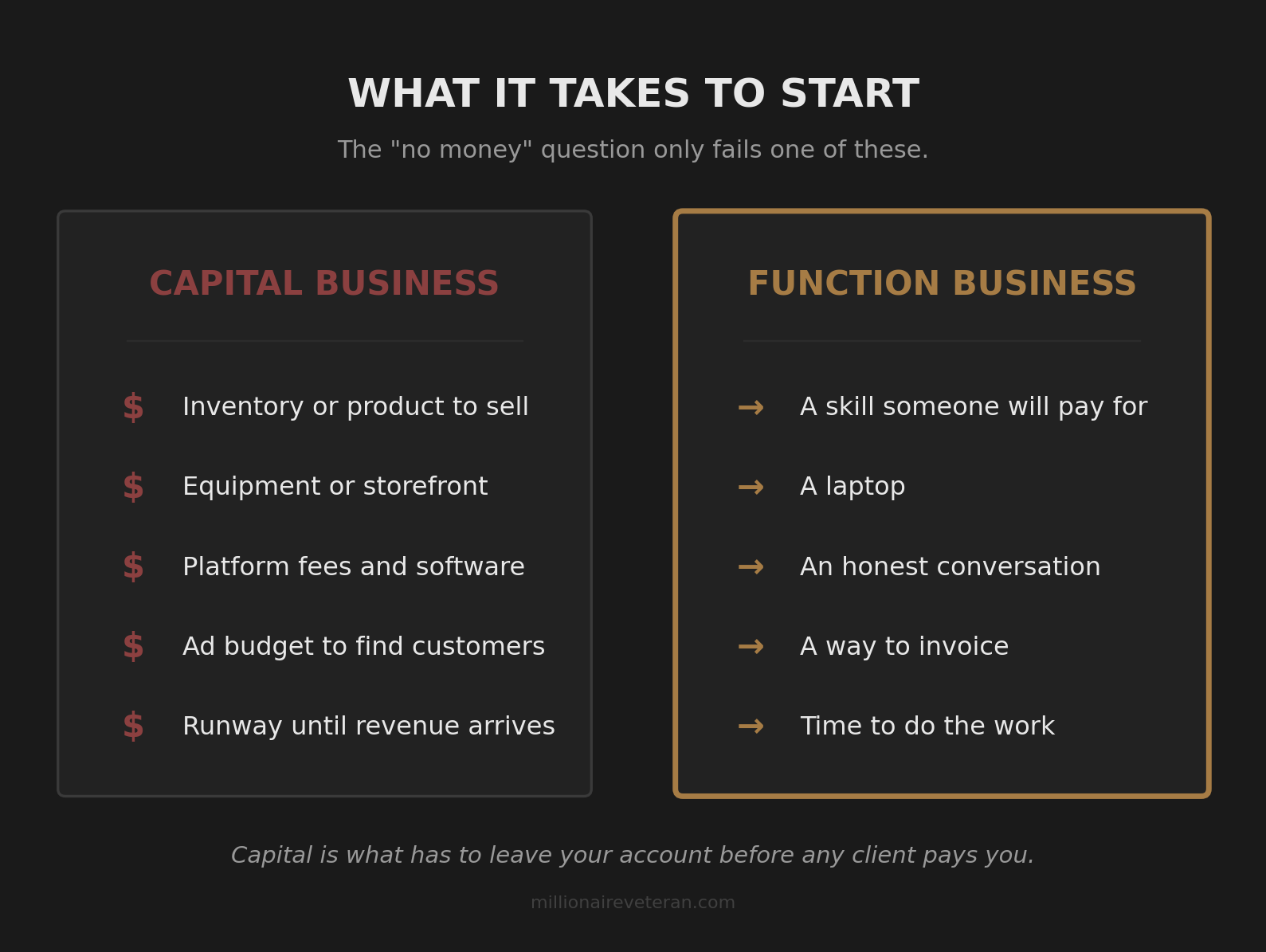
Capital is the money you put into a business before any of it comes back. It funds the inventory, the equipment, the storefront lease, the platform subscriptions, the ad budget, and the months between starting and earning. Capital is the stuff that has to leave your bank account before any client pays you a single dollar.
The standard advice for “no money” businesses is a list of capital-light businesses, not no-capital businesses. Dropshipping is capital-light because you do not buy inventory, but the platform fees and ad spend are still capital. They got moved from inventory to advertising. The capital requirement did not disappear. It hid.
Resources are different. You probably have a phone. You probably have an internet connection. You almost certainly have at least one skill that someone would pay for, even if you do not currently see it that way. You have time, even if it is fragmented. You have access to people who own small businesses, because every neighborhood, every base, every community has them.
That is what “no capital, plenty of resources” looks like. It is the entire foundation for the kind of business that actually works when your bank account is at zero.
The mistake is treating “no money” as a constraint on the type of business you can build. It is not. It is a constraint on what kind of asset that business can be built around. If the asset is something you have to buy first, you cannot build it. If the asset is something you already have, you can.
Why Every Standard Answer Fails the Test
Apply this test to any “no money” business idea: remove the marketing layer, remove the platform, remove the trend. What is left? Does the work produce income from real customers paying real prices for real value? Or does the income come from somewhere else?
That test is uncomfortable for most of the popular answers. The article on recognizing bad business advice walked through how the online business education industry teaches this differently. Most of the answers you find when searching for how to start a business with no money come out of that same industry, repackaged as advice instead of as a course you have to buy. Same patterns. Different wrapper.
Run the test on the popular answers.
Dropshipping is selling someone else’s product without holding the inventory. The supplier ships it, you take the margin. The work is finding the product, setting up the storefront, and running ads. Strip out the ads and the answer falls apart, because dropshipping does not have organic discovery. You either pay for traffic or you do not have customers. The capital requirement got moved into the ad budget, not eliminated.
Affiliate marketing is earning a commission for sending traffic to someone else’s product. Same problem. You either pay for the traffic or you build it through a content engine that takes years to mature. People who tell you to start with affiliate marketing rarely mention that the people earning real income from it have been at it for three to five years.
MLM fails the test on the income side. Look at the income disclosure statements the companies are legally required to publish. The vast majority of participants do not earn meaningful money from selling product to end customers. The income that does exist comes from recruitment. That is not a business. It is a recruitment chain that uses a product to legitimize itself.
Crypto and trading are not businesses at all. They are capital allocation strategies. You cannot start them with no money, and the people who claim otherwise are usually selling something else.
A YouTube channel or content business can work, but the timeline is years, not weeks. If you have no money and you also have a financial gap that needs closing this year, content businesses do not solve the problem in the timeframe you actually need.
The pattern is consistent. Every answer either requires capital you do not have, or requires time on a scale that does not match someone trying to close a real gap right now.
There is a different category of business that does not have this problem.
Capital vs. Function: Two Different Businesses
Every business is one of two types.
The first type sells a thing. Inventory, equipment, a physical product, a digital product with development costs, a service that requires expensive tools or a storefront. These businesses run on capital. The asset is the thing being sold, and the thing has to exist before anyone buys it.
The second type sells a function. A skill applied on behalf of a client. The asset is the skill itself, which lives in your head and your hands. The work happens, the client pays, and the next month it happens again. There is no inventory, no storefront, no equipment beyond a laptop, and no upfront capital required to deliver the service for the first time.
The Three Business Functions framework covers this in detail. Every business that exists, from the photographer at your last base to the bakery in town, runs on three constant functions: Marketing, Accounting, and Operations. The product or service being delivered is the variable. The functions are constants.
Most people who think about starting a business think about the variable. What product? What service? What thing am I going to sell? That is the wrong first question when you have no capital, because every variable they are picturing requires money to produce.
The right question is which function. Marketing, Accounting, or Operations. Pick one, and you are looking at a business that someone else has already paid to build for themselves and now needs ongoing help to maintain. The skill itself is the asset, the work happens on a laptop, and the client pays for any tools or ad spend out of their own budget.
The Three Zero-Capital Starts
Each of the three functions becomes a service business at the entry level. Each costs effectively nothing to start. Each has businesses near you that already need the work done.
Marketing as a service. Small businesses need to be found. They need a Google Business profile that actually attracts calls. They need social media that someone is paying attention to. They need ads that target the right people without burning the budget. Most small business owners do not have the time or the inclination to handle any of this themselves. The skill stack is approachable: Canva for visuals, Meta Business Suite for paid ads, basic copywriting for posts and emails. The starting price for managing a single client’s social presence runs $300 to $500 a month. None of that requires you to spend money first. The client pays for any ad spend out of their own budget. You manage the work.
Accounting as a service. Small businesses need their books kept. Every transaction categorized, every account reconciled, monthly reports run, tax-time chaos avoided. The skill stack is QuickBooks Online, basic bookkeeping principles, and the discipline to do it the same way every month. QuickBooks ProAdvisor training is free. Bookkeeping clients run $200 to $400 a month at the entry level for a single small business. As experience grows and the work moves from data entry into advisory, the rates grow with it. The first client requires zero capital. You log in, you do the work, you invoice.
Operations as a service. Small businesses are running on chaos. Scheduling done through text messages. Invoicing in spreadsheets or not at all. Client onboarding that is different every time. An operations person walks in, audits the workflow, and builds systems that eliminate hours of weekly manual work. The tools are mostly free or cheap subscriptions the client pays for. The skill is knowing which tool fits which problem and how to wire them together. One-time operations setups run $500 to $1,500 depending on scope. Recurring operations support runs $300 to $800 a month. Capital required: zero.
These are not hypothetical price points. They are the actual range for entry-level service work in these three functions. The variation comes from your local market, your experience level, and how you position the work. The floor is real.
One client in any of these three categories closes a meaningful chunk of the gap from the first article in this series. Two clients close most of it.
What Starting a Business With No Money Actually Looks Like
The first thing that happens is not a website. It is a conversation.
You learn enough of the function to be useful. Not expert, useful. Bookkeeping fundamentals plus QuickBooks Online. Or Canva plus Meta Business Suite. Or a working knowledge of Calendly, Stripe, and a basic CRM. The learning happens through free resources that already exist on the internet, structured by what you actually need to deliver to a real client. The community has curated starting points for each function so you are not guessing what to learn next.
Then you talk to someone you already know who knows a small business owner. A neighbor with a side photography business. A friend whose family runs a cleaning company. The barber who cuts your hair. Anyone who runs anything for themselves. You tell them what you are doing and you ask if they need help with the function you have learned. Half of them do. Most of those have never been asked.
The first client comes out of that conversation, not out of a Facebook ad. You agree on a scope, you agree on a price, you do the work, you invoice through Stripe or PayPal or a Word document and a Venmo handle. The first invoice paid, regardless of size, is the moment the business exists.
What does not happen in this version: there is no $997 course you bought before earning your first dollar. There is no website you built and tweaked for three months while telling yourself you were starting a business. There is no LLC filed before there was a single client. There is no “passive income” that arrives while you sleep. The work is real and someone is paying for it because it produces real value.
The first client is a function of how many honest conversations you have, not how polished your branding is. People hire people they trust to do the work. That trust comes from the conversation and the proof of the function, not from the Instagram aesthetic.
The “No Money Down” Trap
Here is the part to watch for.
The same online business education industry that fails the structural test on its own products has noticed there is a large audience searching for how to start a business with no money. That audience is being targeted right now. The pitch goes something like this: free training, no investment required, watch this video and we will show you the system.
The free training is a sales mechanism for a $997 to $5,000 program. The system is a recursive funnel that looks remarkably similar to the one the Guru Problem article walked through. The promise is that you can start with no money. The actual transaction is that you have to buy the program first.
If you have no money and someone is asking you to invest in their course before you have earned a single dollar from a real client, that is the trap. Real service businesses do not require you to buy a course before you can sell the function. The function exists. The clients exist. The work is the asset. Anyone telling you otherwise is selling the dream, not teaching the skill.
The structural test catches this every time. Strip out the course-and-coaching layer and look at where the money is coming from. In real service businesses the income comes from clients paying for work delivered. In the funnel version the income comes from the next layer of buyers who got pitched the same dream you got pitched. That is the structural difference between a real business and a recursive sales chain.
You can start a service business with no money. You cannot start one if the first move is paying $997 to learn how.
After the First Client, the System Has to Hold
The first client is the proof that the business exists. The second one is the proof that it is repeatable. After that, the math gets interesting because new income shows up in your account and immediately starts pulling against everything else.
This is the failure mode that catches most new service business owners by surprise. The $250 from the first bookkeeping client does not feel like much, so it gets absorbed into normal spending. Two months later, the bank account looks the same as it did before, and there is nothing to show for the new work except more of it.
The Compass Method cash flow system handles this by routing every dollar of income, including the new dollars from the side business, by purpose. New income gets a job before it shows up. Without that, earning more raises the floor alongside the ceiling and the gap stays the same size it always was.
The Earn More side does not work in isolation. The income coming in is half the equation. The structure that makes the income stick is the other half. Both have to be running for the gap to actually close.
Where to Start
The Millionaire Veteran community is where this lives. Free curricula for each of the three functions, with starting points that match what you actually need to learn first. The Cash Injection Playbook with verified tactics members have actually tested, not a recycled list pulled off some guru’s blog. The Compass Method so the income you earn routes somewhere instead of disappearing. And the people who are running these same plays alongside you, finding their first clients, working out their first pricing, and building service businesses without buying anything they cannot afford.

About the Author
Joshua Breaux
Retired U.S. Marine
Financial Management Analyst
BS & MBA in Analytics
His family runs on the same systems he teaches here.
This content is educational and does not constitute personalized financial advice. Millionaire Veteran is not affiliated with the Thrift Savings Plan, FRTIB, or the U.S. Government. Past performance does not guarantee future results.