

Something breaks and the repair comes to $2,200. If the money is already sitting in an account whose only job is that, the week is annoying and then it is over. Nothing goes on a credit card. Nothing that was already moving has to be unwound, no paused debt payoff, no bill pushed to next month. That is the entire product. An emergency fund does not make you wealthy and it will never be the best-performing dollar you own. What it buys is the ability to absorb a hit without changing course.
Which makes the question of how much you should have in an emergency fund worth answering precisely rather than approximately.
The standard answer is three to six months of expenses. That answer is directionally right, and it is also incomplete in a way that costs a lot of people the fund entirely. Every version of it leaves out the part that decides the number: which expenses go under the multiple. Everything that leaves your account is one denominator. The part that has to be paid no matter what is a very different one. The gap between them is the difference between a target you hit and a target you look at once, do the math on, and quietly abandon.
The Short Answer, and What It Leaves Out
Three to six months of expenses.
That is where the entire internet lands, and it is a reasonable place to land. The range is not the problem. It reflects a real trade-off between coverage and opportunity cost, and no honest article is going to hand you a single universal figure.
The problem is the word “expenses,” which every version of this advice leaves undefined. So the reader fills it in with the only number they can actually see, which is everything that left the account last month. Rent and the streaming services. Insurance and the takeout. The utility bill and the impulse purchases. All of it gets averaged into one figure, multiplied by three or six, and presented as the target.
That target is inflated by every dollar of discretionary spending inside it. And discretionary spending is exactly the category that stops during the event the fund exists to survive. Nobody keeps four subscriptions running through a stretch with no income. Sizing a fund to cover them is sizing it for a scenario that will not happen.
A multiple is only as honest as the number you multiply.
So the real answer to how much you should have in an emergency fund comes in two parts. Pick a multiple, which is a judgment call about your own risk. Then build the number you are multiplying, which is not a judgment call at all. That part is arithmetic, and it has a right answer.
Which Expenses Actually Count
Three layers. The first two go under the multiple. The third stays out.
Essential Fixed Costs
These are the obligations that arrive whether or not you are earning. Housing. Insurance premiums. Utilities. Any minimum payments carried. The defining feature is that your behavior between now and the due date does not meaningfully move the amount. You cannot grocery-shop your way out of a housing payment, and stopping it produces a consequence you do not control.
This layer is the hard floor of the denominator. It is also the easiest layer to get right, because these numbers are already sitting in a banking app as recurring drafts with the amounts printed next to them.
Essential Variable Costs
Food. Fuel. Household supplies. Still required, still has to be paid, but the amount responds directly to decisions made in a given week.
The system default covers essential fixed costs only. Including the variable layer buys coverage for a longer interruption, the kind where food and fuel spending shrinks but does not stop. Whether to include it is a decision that belongs to you.
Size it forward rather than backward. Ask what the realistic minimum is that you can sustain week after week, not what last month’s grocery total happened to be. That number lands below your normal spending and above the bare bones fantasy you would write down if nobody was going to check it.
What Stays Out
Discretionary spending. Subscriptions, dining out, entertainment, the category the Compass Method calls Lifestyle.
None of this is frivolous by definition and none of it needs defending. It stays out of the denominator for a mechanical reason: during a real income interruption it stops, because the money is not there. Funding three months of it means funding a scenario that will not occur, and it inflates the target by every dollar.
If the line between essential and discretionary is where you get stuck, that is a labeling problem with its own test, and needs vs wants walks four gray-area items through it. Settle those there, then come back here with a number.
How Much You Should Have in an Emergency Fund: Run Your Own Number
Here is one household’s arithmetic. The figures are illustrative rather than recommended, and the fixed stack is deliberately the same one used in that needs versus wants walkthrough so the two articles agree with each other.
Essential fixed costs: housing $1,250, insurance $180, utilities $210, one minimum payment $95. Subtotal $1,735. Essential variable costs: $750 covering food, fuel, and household supplies. Essentials total $2,485. Discretionary: $915. Total monthly outflow: $3,400.
Now apply the same three-month advice twice.
Against total outflow, the target is $10,200. Against essentials, it is $7,455. Same household, same advice, two answers, separated by $2,745. That $2,745 is three months of discretionary spending, which is money that would not be moving during the exact event the fund is there to cover. If you have been carrying the larger version of this number in your head, you have been carrying a target inflated by spending you were never going to do.
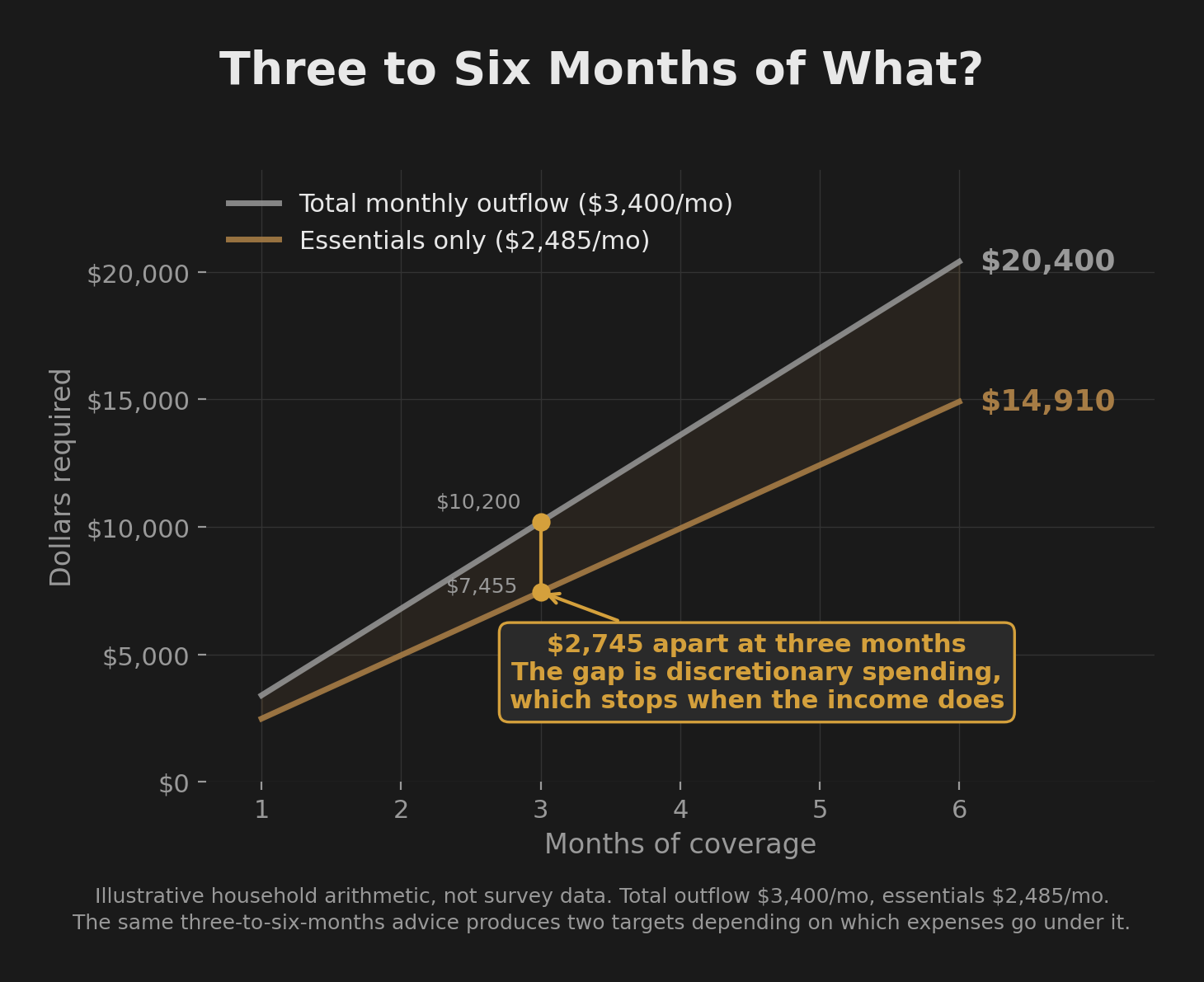
Three steps settle how much you should have in an emergency fund, and you run all three on your own figures. One, add up what arrives whether or not you are earning. Two, add the realistic minimum for food, fuel, and household supplies. Three, pick your multiple. The first two steps are addition, and the third one is not.
That third step belongs to you, and it is worth knowing where a system that has to pick a default lands. The Compass Method’s default target is three months of essential fixed costs, which for this household is $5,205. The stated minimum is one month. Anything above the default is a deliberate purchase of more room, and the person carrying the risk is the one who decides how much room is worth buying. A single income source and a specialized skill set argues for more. Two income sources and a general skill set argues for less. Neither answer is wrong.
Why This Question Lands Differently in a Military Household
The failure being described here is not a military failure. A target sized against the wrong denominator, money pooled in one account, and a fund that drains without anyone deciding to drain it: that happens to commission earners, freelancers, hourly workers, gig drivers, and salaried households with perfectly steady deposits. The mechanism has nothing to do with how the money arrives.
What is different in a military household is the shape of the risk, and it changes how you size the fund in three specific ways.
Start with the composition of take-home. A meaningful share of it arrives as allowances rather than base pay, and those allowances end when service ends. Size an emergency fund against the essentials you pay while receiving them and you have sized it against a cost of living that something impermanent is partly absorbing. The number covering three months of essentials today is not the number covering three months of essentials afterward.
Second, the largest foreseeable interruption to that income is a transition you can usually see on a calendar. Most people never get advance notice that their income is about to stop. That advance notice is a real advantage. It converts a fund you would otherwise guess at into a fund you can size deliberately against a known date. That only pays if you treat the date as a funding schedule rather than a deadline, because the months in between are the ones doing the work.
Third, for Guard and Reserve households the arithmetic inverts. Drill pay is steady. The civilian job is where the interruption actually happens, so the fund gets sized against civilian income and civilian obligations.
Day to day, for someone on active duty with a stable deposit landing on schedule, the fund’s real job is closer to absorbing one large unplanned cost without reaching for a credit card, repeatedly, across years, than to surviving a sudden layoff.
An Emergency Fund Is Not a Sinking Fund
An emergency is unplanned. That word does all the work in this section.
A sinking fund covers spending you already know is coming and can put a date on. Annual insurance premiums. Holidays. The vehicle you will eventually replace. None of that is an emergency. Each one is a known bill you have not paid yet.
The distinction sounds academic until you watch what happens without it. A vehicle failure is an emergency. A vehicle you know you will replace is not. Put both in the same account and the second one drains it on schedule while wearing the costume of the first. Every withdrawal feels justified, because every withdrawal is for something real. The account still reads near zero on the day something genuinely unplanned shows up.
Under the Compass Method these are two accounts for exactly that reason. Emergency holds the unplanned. Planned holds the spending you can name a date for. Same bank, separate balances, and each balance tells the truth about the one thing it is for. If the instrument itself is new to you, what a sinking fund is covers it properly.
The structure is the problem. Two jobs sharing one account is the most common reason a funded emergency fund does not stay funded.
Where the Money Has to Sit
A correct number in the wrong account is not an emergency fund. It is a slightly larger checking balance, and it will behave like one.
Three requirements, and none of them name a product.
Separate from the account you spend from. A balance you can see while standing in a grocery store is a balance you will spend. Not deliberately. Gradually, because a number that large makes every small purchase look affordable, and the fund quietly starts underwriting a normal week. Separation is what makes the number mean something.
Reachable, with friction. You should be able to get the money when you need it without a penalty, a waiting period, or a phone call. You should not be able to get it with a debit card swipe. Under the Compass Method the money moves out of Emergency into Essentials and gets paid from there, which makes every use of the fund a decision somebody made instead of something that happened. That extra step is the feature.
Not exposed to market risk. The fund’s whole job is to be exactly the amount it says it is on the worst possible day, and bad days for your income have an unhelpful habit of arriving during bad months in the market. Growth is a different account’s job.
I am not going to name an account type or quote a rate here. Rates move constantly, and the specific product matters far less than whether those three requirements are satisfied.
The Buffer Comes Before the Full Fund
Three months of essentials is a real number, and for plenty of people it is a long way off. If your honest position is that nothing is left at the end of the month to route anywhere, the full target is not your next move.
The starter buffer is. One thousand dollars in a separate savings account, doing one job: keeping the next surprise off a credit card.
That size is not arbitrary. The Federal Reserve’s Report on the Economic Well-Being of U.S. Households in 2025 found that 63 percent of adults said they would cover a hypothetical $400 emergency expense using cash, savings, or a credit card paid off at the next statement. The remaining 37 percent would have borrowed, including on a credit card carried past the statement, sold something, or not been able to cover it. A thousand dollars covers most of what actually shows up in a given year. It does not cover an income interruption, and it is not built to.
Two stages, in order. The buffer stops small hits from becoming debt. The funded net covers a stretch without income. On the Azimuth Roadmap the buffer is its own milestone, and it gets funded before anything flows toward debt payoff or investing, because attacking debt without a buffer rebuilds the debt the first time something breaks.
The buffer is a stage in that sequence. Reading it as a shortfall gets the sequence backwards, because it is the part of the answer that comes first.
If the buffer itself is out of reach, the constraint is cash flow rather than willpower, which is a different problem with a different fix. How to save money on a tight budget is written for the reader who has already cut the obvious things.
Your Number, and the Structure Around It
You now have the three pieces the standard advice leaves out. A denominator built from what gets paid whether or not income arrives. A multiple chosen against your own risk. And an account you must decide to reach into.
What is missing is mechanical. Money has to arrive in that account every payday, without a fresh decision each time. Willpower is doing that job for most people, and it fails.
The Emergency account lives inside the cash flow system that routes money into it on payday. Six accounts, each with one purpose, funded in a fixed order. The routing that fills your emergency fund fills everything else.
Fix the cash flow first. Everything else gets easier.
Build Your Emergency Fund Number With Your Real Numbers
The Compass Method setup inside the Millionaire Veteran free community walks you through separating money by purpose at the bank account level, and the Diagnostic Review places you on the Azimuth Roadmap using your real numbers. The AI advisor inside the community works your essential fixed costs out of your actual take-home and actual obligations, sizes the target against them, and calculates what reaches that account each payday. The community is free. There is nothing to buy, and the work gets you an emergency number that stays funded instead of one that quietly drains.

About the Author
Joshua Breaux
Retired U.S. Marine
Financial Management Analyst
BS & MBA in Analytics
His family runs on the same systems he teaches here.
This content is educational and does not constitute personalized financial advice. Millionaire Veteran is not affiliated with the Thrift Savings Plan, FRTIB, or the U.S. Government. Past performance does not guarantee future results.