

Someone is waiting on a number from you. A lead asked what you cost, or a client asked what the next stretch of work runs, and the only reference point in your head is what an office job pays per hour. So that becomes the anchor, and the quote gets built downward from it.
People who search how much do virtual assistants charge want a figure. There is a real one, it comes from an actual survey of working operators, and it is in the next section. The figure is not the useful part. Almost nobody who is stuck on price is stuck on their opening number. They are stuck because they named it once, never moved it, and now the calendar is full while the income sits exactly where it was.
A virtual assistant rate has two boundaries, and they get found in completely different ways. There is a floor you calculate, which is what delivering the work actually costs you once tax, unbilled hours, and unpaid weeks come out of the number. And there is a ceiling you discover, which is what real prospects will actually pay, found only by putting a price in front of someone who is free to say no.
Treating your opening number as both is the whole trap. This article separates them, gives you the method for each, and hands you a way to tell when a standing rate has gone stale.
What Virtual Assistants Actually Charge
One number here comes from real methodology. US-based virtual assistants reported an average of $35.61 per hour in Project Untethered’s 2024 survey of 147 VAs working across six continents. Shorthand for the rest of this article: VA means virtual assistant, not Veterans Affairs.
That survey is self-selected. It is 147 people who found the questionnaire through virtual assistant communities and training newsletters and chose to answer 43 questions about their own pricing. So read it as a directional reference point from working operators rather than a rate table, which is exactly what makes it worth citing at all.
Search how much do virtual assistants charge and you will also find pages quoting four dollars an hour and pages quoting eighty. Most of those are marketing published by agencies that sell VA placement. They state no methodology, and they blend US and offshore rates into one “VA cost” range. The same survey put Philippines-based VAs at $11.33 an hour against $35.61 for US-based operators. Average those together and you produce a number that describes nobody.
The service-by-service landscape, which categories of virtual assistant work pay what and how a first client actually arrives, already exists at starting a virtual assistant business. That article is the practice. This one is the price.
So hold $35.61 as a reference point and nothing more. It is an average spanning generalists and specialists, first-year operators and people six years in. The rest of this is how you build your own.
You Are Pricing Against a Wage, Not a Rate
Virtual assistant work looks like a job somebody outsourced. Inbox, calendar, vendors, scheduling, follow-up. A person used to do that at a desk inside the building, and that person got a wage. So both sides of the quote quietly reach for the wage as the anchor. The client is thinking about what an admin costs. The operator is thinking about what an admin job once paid them. Against that comparison, $35 an hour sounds like nerve.
The comparison is broken, and the break is arithmetic rather than attitude. An employer pays the wage and then pays on top of the wage: their half of payroll tax, paid leave, health coverage, any retirement match, the workstation, the software licenses, the training. None of it appears in the hourly figure anybody quotes, and all of it is real money spent to get one hour of work out of one person.
A client pays you a single number. That number has to absorb every one of those items, because nobody else is covering them for you.
This work is the Operations function, one of the three functions every business runs alongside Marketing and Accounting. The three business functions covers why all three exist in every business and why an owner rarely wants to run all three personally. For pricing purposes the point is narrow: you are selling a function rather than filling a seat.
Build the Floor Before You Pick a Number
Your floor is what an hour of delivered work costs you, and you can work it out at a desk without talking to a single client.
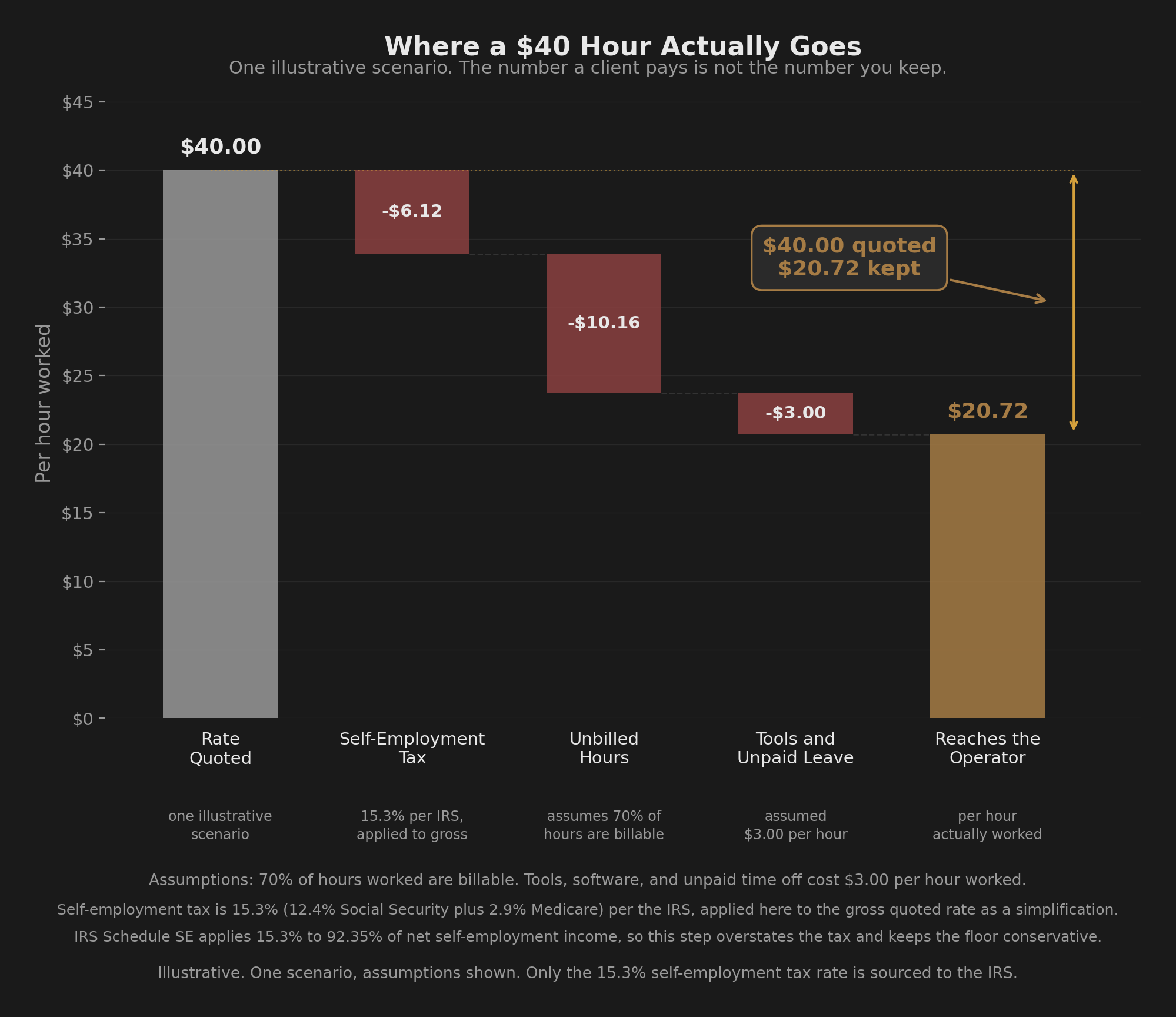
Start at the rate you quote, then subtract.
Self-employment tax comes off first. It runs 15.3%, which is 12.4% for Social Security plus 2.9% for Medicare, per the IRS. An employee splits that burden with an employer. You do not have one, so both halves are yours.
Unbilled hours come off next, and this is the subtraction most operators never make. Invoicing, proposals, prospecting, contract cleanup, the client messages that are not the work but still eat the afternoon. Those are hours worked. They are not hours billed. If seven of every ten working hours are billable, your effective rate is seventy percent of the number you quoted, and the missing thirty percent is time you gave away. I track mine rather than estimate it, because the estimate is always generous.
Then unpaid weeks. There is no accrual and no holiday schedule, so any week you are not delivering has to be carried by the weeks you are.
Then tools. Scheduler, storage, password manager, accounting software, anything the client work requires that the client does not pay for directly.
Now run it backward, because that is the version you can actually use. Start from the take-home you need per month. Divide by the hours you can realistically bill, not the hours you can work, since those are two different numbers and confusing them is how rates end up underwater. Then gross up for tax. What comes out the other side is your floor.
The floor is not the price. It is the line beneath which delivering the work costs you money. How far above it the price should sit is a separate question, and no amount of arithmetic will answer it.
Find the Ceiling: The No Rate
Start with the question that actually drives people to this search. Fully booked for weeks, and the money still is not where it needs to be. Raise prices, or stop taking work?
Neither, quite. A full calendar is a price signal, not a scheduling problem. When every available hour is already sold, demand has told you the number sits under what this market will pay. You cannot work hours you do not have, and closing the door just caps you where you are. The next quote goes up.
Which requires measuring something most operators never track. Your No Rate is the share of your quotes that get turned down.
Most people stuck at a rate have a No Rate of zero and read it as a good sign. An untested price and a correct price look identical from the inside, and the only thing separating them is whether anyone ever had room to refuse. A price nobody refuses is a price you never tested.
Somebody in a small-business forum thread said it less politely: “If people ain’t saying no, you ain’t charging enough.” Anonymous, no data behind it, and still the right instinct. Declines are the only feedback loop pricing has.
The mechanic is specific. Raise on the next new quote, not on existing clients mid-engagement, because a surprise rate change costs more in trust than it gains in revenue. Existing clients get notice and a renewal date. Move in defined steps rather than doubling and hoping. Quote the higher number three or four times before you judge it, since one decline is noise and three is a pattern. Stop when declines start arriving at a rate you can absorb. That point is the ceiling, and you did not calculate it, you found it.
The guardrail matters as much as the mechanic. The No Rate only locates a ceiling inside the client market you are already selling into. If every prospect says no, the number is not the problem. That market cannot pay it, and pushing the price further inside it produces zero clients instead of more income. The move there is a different client market. A cheap one stays cheap no matter what number you put in front of it.
The floor is arithmetic, and you can do it alone at a desk tonight. The ceiling is information, and information only comes from quoting real people and counting what comes back.
Pick the Shape That Stops Punishing You for Getting Faster
Everyone tells virtual assistants to get off hourly, usually without saying why. For Operations work the reason is structural, and it cuts harder than the usual complaint about capped hours.
Operations work rewards efficiency, and you will get more efficient. Six months into a client you have built the templates, the saved replies, the routing rules, the standing agenda. Scope that took eight hours a week takes four. Under hourly, you just halved your own pay for getting better at the job. Competence is the thing being penalized.
The survey shows what staying there costs. 72% of VAs charge hourly, half use monthly retainers, and about a third price by project, which adds past 100 because 56% run different structures with different clients. The project-priced group reported higher monthly income while working fewer hours, 19 a week against 22.
Two ways off pure hourly, both real.
An hour-block retainer is a fixed number of hours per month at a fixed price. It still counts hours, so the efficiency problem is only half solved, but the income stabilizes and the client commits. An hour-block retainer is a first step off pure hourly.
A scoped retainer is a defined recurring deliverable at a fixed price with hours uncounted. Inbox held to a stated response standard, calendar managed, vendors handled, one monthly report. Now getting faster is yours to keep.
The general comparison of pricing shapes, and how to say a number out loud without flinching, lives in pricing social media management. The Operations argument is the efficiency penalty, and it is the one that should decide this.
There is a second reason for anyone whose working hours are irregular and not entirely theirs to control. Hourly ties income to a schedule that can change without notice. A scoped retainer ties income to a deliverable, and deliverables move inside a bad week. In that survey 57% of VAs worked twenty hours a week or less, so this is work that fits beside an existing obligation. A few scoped retainers become a recurring floor, and a recurring floor is what closes the gap military pay leaves.
The Creep That Eats an Operations Retainer
Marketing scope is a list. Two platforms, twelve posts, community management, monthly report. You can write it down before you quote it, and both sides can see the same thing.
Operations scope is defined by what it catches, which is the entire reason the role exists. “Handle my inbox and calendar” has no bottom, because absorbing whatever falls out of the client’s day is the job. Nobody can enumerate what has not happened yet.
So the failure mode here is not a bad opening quote. It is a good quote that quietly decays. Inbox and calendar becomes inbox, calendar, chasing the vendor, answering the customers, booking the travel, and pulling a monthly report, one small favor at a time. Every addition was reasonable. None of them were priced. The tell is worth naming plainly: the work feels heavier and the invoice is identical.
The fix is mechanical. Write the scope down where the client can see it, so there is a document to point at instead of a feeling to defend. I put mine in writing before the first invoice, not after the first drift. Reprice on addition rather than on resentment, which means the answer to a new request is yes, and here is what that changes, said at the moment of the request instead of three months later. Set a review date so the scope conversation is scheduled rather than confrontational.
One drift is worth catching early. When the role starts absorbing the books, or starts running social, that is Accounting or Marketing work being delivered at an Operations rate, and it is a pricing problem before it is a workload problem.
Pricing Is the Operations Function Pointed at Your Own Business
The Operations function is the discipline of building systems that stop things from leaking. Undefined scope, unexamined processes, work happening that nobody owns. That is what a client pays you to find inside their business.
The business almost nobody points it at is their own. A rate set once and never revisited is an unmanaged process sitting in the middle of your operation, doing exactly the thing you get paid to catch elsewhere. Reviewing the number on a schedule, tracking what gets declined, repricing when the scope moves. That is the same competence turned inward, and it is the difference between holding a rate and running a business.
The question of how much do virtual assistants charge has a floor answer and a ceiling answer, and only one of them can be worked out on paper. Getting both is the Sell It step of Learn It, Use It, Sell It, the model where a skill built for one purpose ends up paying you twice. The same reasoning applied to the Marketing function is how much to charge for social media management.
Build Your Operations Practice Past the Opening Number
Earning more works on two timelines, and the Millionaire Veteran community is built around both. The Cash Injection Playbook is the fast lane: one-off moves that put cash in hand for momentum, inefficient-debt paydown, or a near-term gap. Learn It, Use It, Sell It is the long lane. This article walked the Operations function; the same logic builds Marketing and Accounting over months and years. Both live in the same free community alongside the Compass Method, the cash flow system that routes any new dollar to a purpose instead of lifestyle creep. Members are building it together as they execute. Free.

About the Author
Joshua Breaux
Retired U.S. Marine
Financial Management Analyst
BS & MBA in Analytics
His family runs on the same systems he teaches here.
This content is educational and does not constitute personalized financial advice. Millionaire Veteran is not affiliated with the Thrift Savings Plan, FRTIB, or the U.S. Government. Past performance does not guarantee future results.