

Every financial independence plan runs on one move. Figure out what the household will spend in a year. Subtract the pension. What is left is the gap the portfolio has to cover. The shape of that move is right.
The execution breaks on the first line. The figure almost everyone subtracts is a gross annual number off a retirement calculator or a forum thread, and the gap has to be covered in spendable dollars. Two different quantities. Subtract the wrong one and everything downstream moves with it: the portfolio target, the savings rate, the year you can walk away.
The search that brings most readers here, is a military pension taxable, has a one-word answer. Yes. Military retired pay is taxable income at the federal level. An AI summary hands you that before you click anything, and it is not the part that changes your plan.
The pension is a strong asset. Using the wrong number for it is what breaks the plan. It usually comes from one habit, the marginal-rate assumption, where a single bracket percentage gets applied to the entire pension.
What follows is the conversion: what federal tax does to a gross retired pay figure, what else comes out before the deposit lands, how VA disability moves dollars out of the taxable column, and the method for turning the estimate into a number you can plan against.
Yes, a Military Pension Is Taxable, and It Is Taxed as a Pension, Not a Paycheck
IRS Publication 525 draws the distinction in one sentence: “Payments you receive as a member of a military service are generally taxed as wages except for retirement pay, which is taxed as a pension.” Retired pay based on age or length of service is included in income, regardless of branch or grade.
The reporting form is the tell. Active duty pay arrives on a W-2 as wages. Retired pay arrives on a Form 1099-R issued by the Defense Finance and Accounting Service (DFAS), the same form that reports pension income for civilian retirees.
One structural consequence of being a pension rather than wages: MyArmyBenefits, the Army’s official benefits library, states that Social Security and Medicare taxes are not withheld from military retired pay.
Withholding starts from the DD Form 2656 you complete at retirement. After that you change it in myPay or with a new Form W-4. Not a W-4P, the annuitant form. There is no universal default that DFAS drops everyone into, and electing zero withholding does not make the pay non-taxable. It changes when the tax gets paid, not whether.
Three layers sit between the estimate and the plan: the federal layer, the state layer, and the portion that may not be taxable retired pay at all.
The Number on the Pension Estimate Is Not the Number That Lands
Every pension calculator produces a gross annual figure, and what a military pension is worth as an asset prices that same gross stream as a lump sum. Both are useful starting numbers. Neither is what hits the account. Three things happen in between, and confusing them is where projections go wrong.
Some items reduce the taxable figure. If you receive Department of Veterans Affairs (VA) disability compensation, a portion of gross retired pay is waived, and the waived amount is not taxable retired pay. If you elected Survivor Benefit Plan coverage, the premium is excluded from income before the taxable figure is computed, and Publication 525 states that exclusion directly. What the election buys and why it cannot be undone is what the survivor benefit plan premium buys. Here it is one line item.
Some items do not reduce the taxable figure at all. Federal and state withholding is prepayment of a tax you already owe, not a reduction of it. TRICARE enrollment fees are a voluntary allotment paid out of retired pay, not a pay deduction, and they do not lower taxable income by a dollar. That one gets assumed constantly, and it is wrong.
One item moves the tax to somebody else entirely. Where a court has ordered a division of retired pay under the Uniformed Services Former Spouses Protection Act, DFAS issues the former spouse their own 1099-R for their share.
The gross number and the taxable number are two different quantities, not the same figure before and after tax.
How VA Disability Moves the Taxable Portion
VA disability compensation is not taxable. Publication 525 says not to include veterans benefits paid under any law or regulation administered by the Department of Veterans Affairs, and 38 U.S.C. 5301 makes that exemption statutory. Retired pay is taxable. The VA waiver is what connects the two.
DFAS states the mechanic plainly: the law requires a military retiree to waive a portion of gross Department of Defense retired pay, dollar for dollar, by the amount of VA disability compensation received. That is the VA waiver, and most people have heard it called the VA offset. It is a favorable mechanic. Gross retired pay minus the waived amount is the taxable retired pay, and the VA compensation replacing those dollars arrives tax free. Money moves out of the taxable column and into the tax-free column. Nothing is taken away.
Two programs sit on top of that mechanic.
Concurrent Retirement and Disability Pay, CRDP, restores some or all of the waived amount. DFAS describes it as an increase in retired pay rather than a new payment, which is why it is taxable at your own retired pay withholding rate. It applies to 20-year retirees with a VA rating of 50 percent or higher, with a separate and stricter rule for medical retirees.
Combat-Related Special Compensation, CRSC, is a tax-free entitlement. It requires a VA rating of at least 10 percent and a combat-related disability: armed conflict, hazardous duty, an instrumentality of war, or conditions simulating war. CRSC is not limited to 20-year retirees, and it does not arrive on its own. It takes an application filed with your branch of service.
You cannot receive both. DFAS applies whichever is more beneficial in the first year, and after that the retiree chooses during an open season, usually in January.
Here is the discipline that keeps a projection honest. Do not build a rating into the equation. Treat it as icing. DFAS warns that when a VA rating changes, an increased VA payment is counter-balanced by a decreased retired pay payment, and a retroactive rating creates debits and credits across prior years. If you have a rating, the mechanics above are how it moves your taxable portion. If you do not, a plan built on one you expect is a plan built on a guess.
There Is a State Layer, and It Enters Last
Whether a military pension is taxable at the state level is a separate question from the federal one, and it comes in four shapes. Some states have no income tax at all. Some fully exempt military retired pay. Some exempt part of it, gated by income caps, age thresholds, or dollar limits. Some tax it like any other pension income. Which group a state sits in moves with its legislative sessions. DFAS declines to characterize it and points retirees to their state department of revenue.
What governs is domicile when the pay arrives, not where you served. The Servicemembers Civil Relief Act protections that shield pay from the state where the service member was stationed cover compensation for military service, and military service means active duty. A retiree is taxed where domiciled, like any other resident with pension income.
The state layer enters last because it is the only layer you can still change, and changing it is a life decision with far more inputs than tax. That is its own article: how states actually treat military retirement pay.
Converting Gross Retired Pay Into a Planning Number
Five steps, in order, run against your own projection.
Start from gross annual retired pay. Whatever your estimate produced.
Remove what is not taxable retired pay. The waived amount if you receive VA compensation. The premium if you elected SBP coverage. What is left is the taxable figure.
Apply an effective rate, not a marginal rate. Your marginal rate is what the last dollar gets taxed at. Your effective rate is what the whole amount averages out to once the standard deduction comes off the top and the lower brackets do their work. The gap between them is the largest single source of a wrong projection, and people reach for the marginal rate because it is the number they can name.
Add back the tax-free money. VA compensation arrives whole. So does CRSC, if you receive it.
Apply the state layer, or hold it as a range until domicile is settled.
I will run one illustrative case end to end. Every figure below is an example, not a projection, and the assumptions are stated so you can see what changes if yours differ.
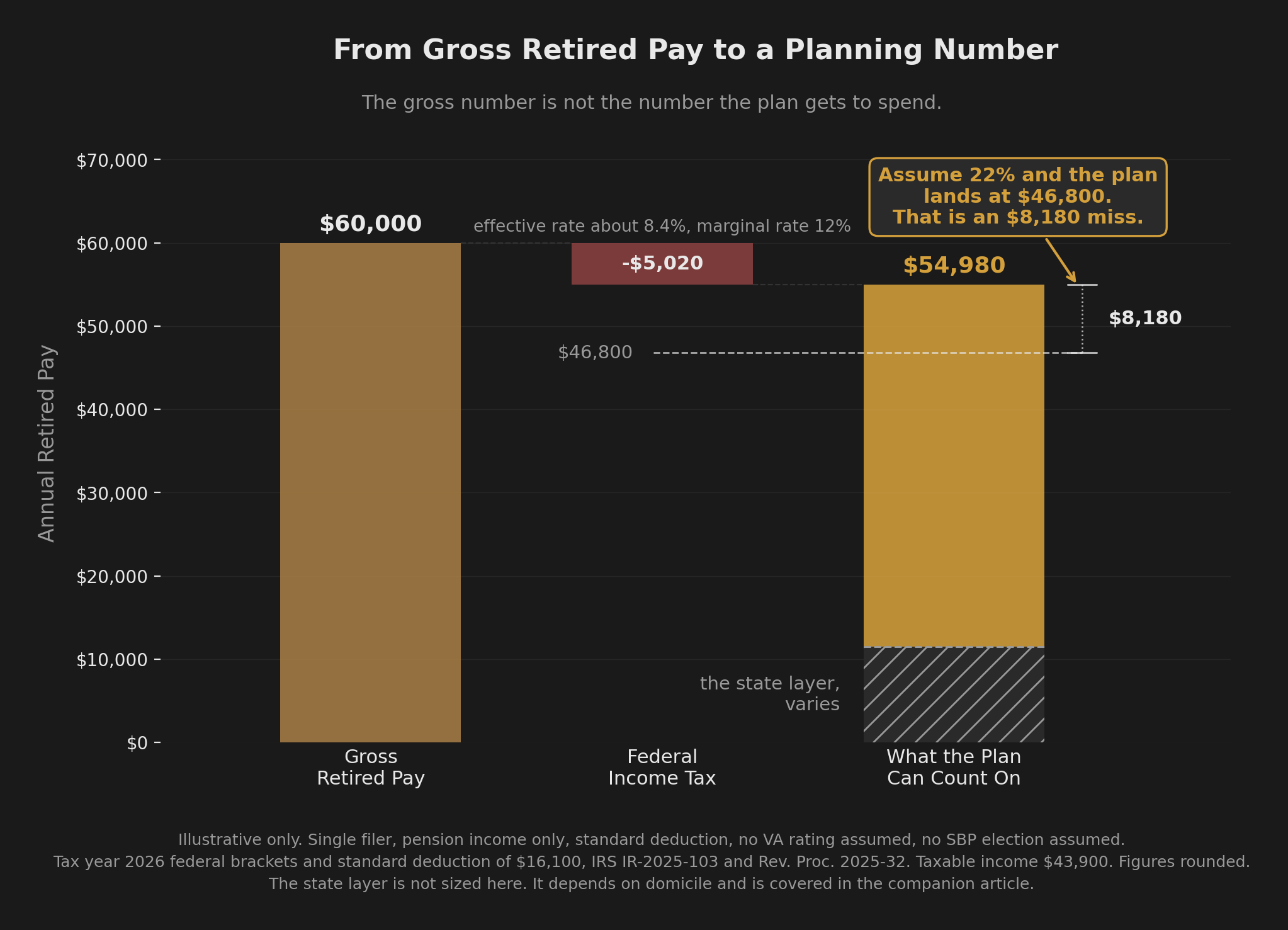
Take $60,000 in gross annual retired pay. Single filer, standard deduction, no other income, no VA rating assumed, no SBP election assumed, tax year 2026. The 2026 standard deduction for a single filer is $16,100, which leaves $43,900 of taxable income. The first $12,400 is taxed at 10 percent, or $1,240. The remaining $31,500 is taxed at 12 percent, or $3,780. Federal tax of roughly $5,020.
Now put the two rates side by side. The marginal rate there is 12 percent. The effective rate, measured against the full $60,000, is about 8.4 percent. And the expensive error is not using 12 instead of 8.4. It is assuming 22 percent, applying it to the whole pension, and writing $13,200 into the plan. The actual federal math lands roughly $8,180 below that.
Your own number depends on inputs this article cannot see: filing status, other household income, whether VA compensation is in the picture, whether you elected SBP, and where you are domiciled. Change any one of them and every figure in the example moves with it.
Three Errors That Break the Gap Math
The first error is using the marginal rate as the effective rate. It over-taxes the projection and makes the gap look bigger than it is. In the worked example that is an $8,180 miss in one year, and repeated across a retirement it is why people conclude the pension covers less than it does and set a portfolio target they never needed.
The second runs the opposite direction. Planning on a rating you do not have under-taxes the projection and makes the gap look smaller than it is. That one is more dangerous, because the correction arrives late.
The third is assuming an aggressive cost-of-living adjustment. Retired pay is adjusted annually under 10 U.S.C. 1401a, effective December 1 each year, by the change in the Consumer Price Index published by the Bureau of Labor Statistics, measured from the quarter ending September 30. That is the mechanism. Any specific percentage belongs to a specific year, and guessing high compounds through every year of the projection, so a small error at the front becomes a large one at the back.
One more item is less an error than a gap the projection hides. Retired pay is not compensation for individual retirement account (IRA) contribution purposes. Publication 590-A lists pension and annuity income under what is not compensation. If your plan has you living on the pension and continuing to fund an IRA out of it, that will not work. Funding an IRA takes earned income: a job, self-employment, or a working spouse income through a spousal IRA.
What This Article Will Not Tell You
The boundary matters here, because tax content that blurs it is worse than no content.
Whether a specific disability retirement qualifies for the Publication 525 exclusion. Four alternative conditions govern that, and the computation turns on facts about the service and the rating involved. Read Pub 525 and take it to a tax professional.
Whether you qualify for CRSC, and whether CRDP or CRSC is better for you. That comparison turns on your own withholding rate and on whether each rated condition is combat-related. DFAS and your branch of service answer it.
Whether a retroactive VA determination reopens a prior tax year. It can, and there is a deadline attached. Route that one, do not guess at it.
Which state you are domiciled in. That is a question of fact with legal consequences.
Rule questions go to DFAS, the VA, your state department of revenue, IRS publications, and a qualified tax professional. Millionaire Veteran is not a financial advisor and not a tax preparer, and is not affiliated with TSP, FRTIB, DFAS, the VA, or the U.S. Government. This is financial education, not personalized advice. Planning questions, meaning what this does to your gap, go somewhere else.
Where That Number Actually Goes
Asking whether a military pension is taxable gets you a yes in under a second. Asking what it leaves you with is the question the plan actually runs on, and it is the only one of the two that changes an input. Gross retired pay is what the calculators hand you. The planning number is what survives the federal layer, the state layer, and whatever portion is not taxable retired pay at all. That planning number is the one the gap math subtracts. Annual spending minus the pension is the gap the portfolio has to cover, and every dollar the five steps correct comes straight off the portfolio target.
That number does not sit alone, and where it stacks against Traditional Thrift Savings Plan withdrawals and Social Security is where the next planning problem lives. For the four-piece picture this number sits inside, including how pension income stacks against other retirement income, read the full military retirement planning guide. For the other side of the same asset, the lump-sum value of the income stream itself, what a military pension is worth as an asset prices it. Where you sit on the FI Spectrum places all of it in the five stages between surviving and independent.
The method above is the part I can hand you. Where your own numbers land is not.
Run the Gap With Your Real Numbers
The Diagnostic Review inside the Millionaire Veteran free community places you on the Azimuth Roadmap using your real numbers: rank, years of service, take-home pay, contribution levels, and current balances. The output is which FI Spectrum stage you are in and which milestone is the next gate. It is not a tax calculator and it is not tax advice. The Compass Method then routes the cash flow so the contributions happen on payday, every payday. The community is free. There is nothing to buy.

About the Author
Joshua Breaux
Retired U.S. Marine
Financial Management Analyst
BS & MBA in Analytics
His family runs on the same systems he teaches here.
This content is educational and does not constitute personalized financial advice. Millionaire Veteran is not affiliated with the Thrift Savings Plan, FRTIB, or the U.S. Government. Past performance does not guarantee future results.