

Starting a virtual assistant business is one of the cleanest zero-capital income paths available in 2026. You do not need a course, a coach, or a credential. You need a real skill, a way to deliver it, and someone willing to pay for it. The rest is operational.
I have watched military spouses and transitioning service members build virtual assistant businesses on the side of unstable military life. The pattern is consistent: real skill, reliable delivery, the willingness to ask for the work. No capital, no certifications, no course required.
The reader who searches “starting a virtual assistant business” usually wants three things: confirmation the work is real and pays, the services that produce actual revenue, and the steps to land the first client. This article delivers all three honestly, including the price ranges that hold across the industry and the operational reality of running the work alongside military life.
This is not a pitch for a virtual assistant training program. There are no affiliate links here. The argument is simple: skill is the starting capital, and the world is full of small businesses who will pay for that skill if you can find them and deliver competently.
What a Virtual Assistant Actually Does
A virtual assistant (VA) is a remote contractor who delivers execution work that the client cannot or will not do themselves. The work is real. It produces measurable value. It is also broader than the title suggests.
The most common VA service categories: inbox triage and calendar management for executives or small business owners; customer service responses and community moderation for online businesses; social media posting and content scheduling; bookkeeping support inside a small business; research and data entry projects; light project management; transcription and meeting notes. Some VAs specialize in one of these and bill $50 to $100 per hour. Some run a general practice across several and bill $25 to $40 per hour. Both models work. The choice depends on what you already know how to do well.
The work is delegated execution. The client tells you what they need, you do it, you report back. The client is paying for two things: the hours they get back to spend on higher-leverage work, and the consistency of knowing the thing they delegated actually got done. Reliability beats brilliance in this business. A VA who delivers what was asked, on time, every time, builds a roster of repeat clients faster than one who is technically brilliant but inconsistent.
The work is transactional. Reliable delivery beats reputation in the early stage, and the pay is real once the delivery is consistent. There is no shortage of small business owners who are drowning in tasks they should not be doing themselves.
Why VA Work Fits Military Life
The work is remote, asynchronous, and modular. Three properties that map directly to how military life actually runs.
Remote means location does not matter. A VA in Camp Lejeune housing serves a client in Austin the same way a VA in Yokosuka housing does. The work crosses time zones because most of it does not need to be synchronous. The client sends the task, the VA delivers when their bandwidth opens, the result lands when needed.
Asynchronous means you do not need to be at a desk during specific hours. Someone managing a household during a deployment can fit two hours of inbox triage into whatever window opens. A dual-military couple can run client work on alternating shifts. A service member at a stable assignment with steady evening hours can serve a couple of clients on the side without it interfering with the primary job.
Modular means you can scale the work up or down without breaking the structure. Take on one client, build the rhythm. Add a second when the first is stable. Pause new client acquisition during a temporary duty (TDY) rotation or a field exercise where bandwidth disappears. The clients who are already in your roster will tolerate a known down period if you communicate it; the work resumes when you do. The broader context for why earning more matters on military pay specifically lives at the military pay ceiling, which sizes the gap that side income is closing.
What does not work: pretending the constraints are not real. A VA whose military life includes regular multi-week stretches with limited connectivity needs to set expectations with clients upfront about scheduled down periods, or build a practice where one client at a time covers a defined window before the next client is added. The constraints are real. They are also not disqualifying. The work travels. The clients stay.
The Services That Actually Pay
The honest landscape of starting a virtual assistant business in 2026, with illustrative price ranges that reflect what the industry actually pays. Specific dollar figures vary by skill level, client size, niche, and how the engagement is structured. The point is the shape of the pricing landscape, not commitment to any number.
Executive support, inbox and calendar management. Entry-level hourly: $20 to $30. Retainer for ongoing weekly support: $400 to $800 per month per client. Skills required: organization, written communication, basic Google Workspace or Outlook fluency, the discipline to triage someone else’s priorities the way they would.
Social media management. Entry-level hourly: $25 to $40. Retainer: $300 to $1,500 per month depending on platform count and posting frequency. Skills required: Canva fluency, a scheduling tool, content writing basics, the ability to maintain a brand voice that is not your own.
Bookkeeping support. Entry-level hourly: $25 to $40. Retainer: $300 to $800 per month for a small business with modest transaction volume. Skills required: comfort with QuickBooks Online or a comparable platform, the patience for categorization, and the willingness to ask clarifying questions instead of guessing.
Customer service and community management. Entry-level hourly: $18 to $28. Retainer: $400 to $1,200 per month. Skills required: clear written communication, patience under stress, the discipline to respond to the same question for the hundredth time without sounding annoyed.
Research and data entry. Entry-level hourly: $15 to $25. The lowest barrier of any VA category and the lowest ceiling. Most VAs use this as a foot-in-the-door category, prove competence on a few projects, then graduate to higher-paying work for the same clients.
Specialized work. Pinterest management, podcast production, course platform operations, online business management. Entry-level hourly: $40 to $75. Retainer: $1,000 to $3,000 per month. Higher skill requirement (specific platform knowledge), significantly higher pay. These categories grew fast over the past five years as online businesses scaled and ran out of bandwidth to manage the operational layer.
The pattern across categories: the more specific the skill, the higher the rate. Generalists who do a little of everything bill in the $20-$30 range. Specialists who own a specific function bill at multiples of that. Most VAs start as generalists, identify the work they enjoy most or are best at, and specialize once they have enough client work to know where the demand and the energy align.
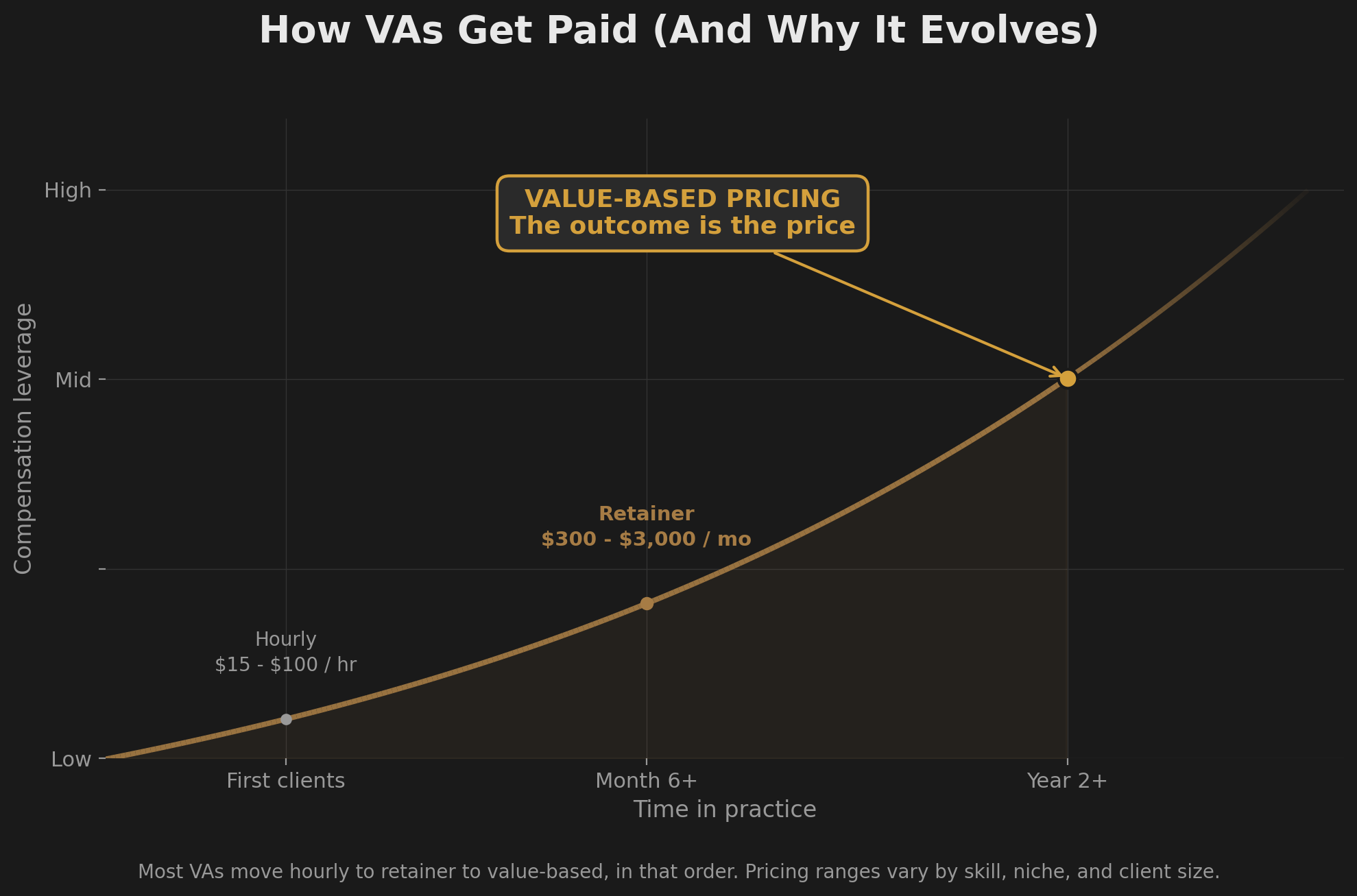
How You Get Paid (And Why It Evolves)
Most VAs default to hourly billing because it is the simplest mental model and the default on every marketplace. It is also the least durable structure for a sustainable business. Hourly billing caps income at the number of hours available, penalizes you for getting faster at the work, and frames every minute of the engagement as something the client is metering.
The compensation structure evolves. Three models, roughly in the order most VAs move through them.
Hourly. The starting point. Right for the first few clients, marketplace engagements through Upwork or Fiverr, and any scope that is genuinely unpredictable. Reality check on the ceiling: at $30 per billable hour and twenty productive billable hours per week (realistic alongside other obligations and life), the math caps near $2,400 per month before platform fees. The longer you stay here, the harder the math fights you.
Monthly retainer. The first level of escalation. The same work delivered as a fixed monthly fee for a defined scope. The client gets budget predictability and a known partner. The VA gets income stability and stops being penalized for getting faster at the work, because the deliverable is the scope, not the hours. As your skill grows and the same scope takes fewer hours to complete, that productivity gain stays with you instead of being clawed back at the time clock. Most VAs move to retainer within the first six months once a client engagement has stabilized.
Value-based pricing. The highest escalation. Pricing the outcome, not the hours. A VA running an executive inbox for a consultant whose hour is worth $500 to the business is worth more than the same VA running an inbox for a course creator earning $50 per hour, because the leverage on the client’s time is fundamentally different. Specialists charge what the work is worth to the client, not what their own hours cost. This requires delivered evidence (case studies, retained clients, demonstrable ROI) which is why value-based contracts usually arrive in year two or three of the practice, not year one.
The progression matters. VAs who stay in business for more than two years tend to move hourly to retainer to value-based, in that order. Trying to skip steps backfires. Pricing strategy is its own discipline, and a full walkthrough of when to graduate between models, how to structure value-based contracts, and how to anchor the price to outcomes instead of hours is a future article in this series. For now: hourly is the start, not the destination. Plan the evolution from day one.
The Operational Reality, No Money Required
The starting checklist, in literal order, with the cost of each item:
- Existing laptop or basic computer access. $0.
- Reliable home internet (already paid). $0 incremental.
- Free LinkedIn profile rewritten to position you as a VA in your service category. $0.
- Free Upwork, Fiverr, Contra, or Belay applicant accounts. $0.
- Free Google Workspace personal account for client document collaboration. $0.
- Free Canva account for any design-adjacent work. $0.
- Free Loom for client communication and project handoffs. $0.
Optional, only after the first client is in: a paid Calendly account at $10 per month for scheduling. A paid Canva Pro account at $13 per month if the work demands it. A paid QuickBooks subscription if you are doing bookkeeping for clients (often the client pays for this directly).
What is not required to start: a business license or LLC formation. A website. A logo. Paid training certifications. Coaching. A “personal brand.” A polished video introduction. Any of these are appropriate at some point in the second year, when revenue is steady and tax structuring matters. None of them are required to land the first client or do the work.
The only starting capital you need is the skill itself.
The work proves itself faster than any credential does. A VA with one delivered project and a screenshot of a satisfied client message has more practical credibility than a VA with three certifications and zero clients.
How to Land the First Client
Three paths. The order matters more than people expect.
Your existing network is the first place to look. A military spouse community, a former employer or coworker, a unit family readiness group, a church or volunteer organization, a college alumni group. Someone inside two degrees of separation knows a small business owner who is drowning in tasks they should be delegating. Tell three or four people in your network what services you are offering and at what entry rate. The first client almost always comes from inside that network. Network referrals close at rates marketplaces cannot touch, and the client comes pre-warmed because someone they trust vouched for you.
Marketplaces are the second path. Upwork, Fiverr, Contra, and Belay are the established platforms in 2026. Belay in particular is military-spouse-friendly and pays well for VAs they accept; the application bar is higher than Upwork but the clients are higher quality. The marketplaces are best used for skill stacking and building a review base early, not as the primary client source long-term. Close rates are low, competition is high, and the fees take a meaningful percentage of revenue. Treat them as a tool for the first few clients, then transition.
Direct outreach is the third path. Identify ten small businesses in a category you can credibly serve. Local realtors, small accounting firms, online course creators, single-practitioner consultants, niche e-commerce stores. Send a short specific message offering one specific service at a specific entry rate. The message says what you do, who you do it for, and what it costs, in three sentences. Most messages get no response. A small percentage convert. The clients who do convert tend to be higher quality than marketplace clients and they pay better.
Run all three paths in parallel. The combination matters: network conversations open the highest-conversion door, marketplace applications build the evidence base, direct outreach builds the discipline of asking for the work. VAs who do the actual work tend to land two or three steady clients and a clear sense of which category they want to grow inside.
One question almost always derails new VAs: what should I charge the first client. The answer is the bottom of the entry range for your category, plus a clear written scope. Charging too little signals you do not value the work and attracts clients who treat you that way. Charging too much without delivered evidence makes the close harder than it needs to be. Land in the lower end of the typical range, deliver the scope cleanly, then raise rates with the next client once the first one is steady. The first client funds the learning. The second client builds the practice. The third client is where the rate increase actually starts producing real income growth.
Your Next Step
Starting a virtual assistant business gets you to the function. The function is what produces income. The next layer is the architecture that turns the function into a durable business pattern: how the VA work becomes a launching pad for a higher-leverage B2B services business, or a B2C product business, or a hybrid that runs both.
That architecture lives at Learn It, Use It, Sell It. It walks through the model where the work you learn for one purpose ends up paying you twice: once as your own competence, once as income from delivering it for others. The VA work covered here is step one. The model around it is steps two and three.
Every skill pays twice.
Build Your VA Business Alongside People Who Are Doing It
The Cash Injection Playbook inside the Millionaire Veteran community is a living resource maintained by members who are actually building this. Real tactics, real client scripts, real pricing references that get updated as members win or lose deals. The community also has the full Compass Method, which is the cash flow system that routes any new VA income into the right accounts so it actually stays instead of disappearing into the pile.
The community is free.

About the Author
Joshua Breaux
Retired U.S. Marine
Financial Management Analyst
BS & MBA in Analytics
His family runs on the same systems he teaches here.
This content is educational and does not constitute personalized financial advice. Millionaire Veteran is not affiliated with the Thrift Savings Plan, FRTIB, or the U.S. Government. Past performance does not guarantee future results.