
You picked the service. You can do the work. You are stuck on the same wall almost everyone hits when they figure out how to get clients for a new business: no testimonials, no case studies, no track record, and a quiet voice asking why anyone would hire you over someone who has been doing this for years.
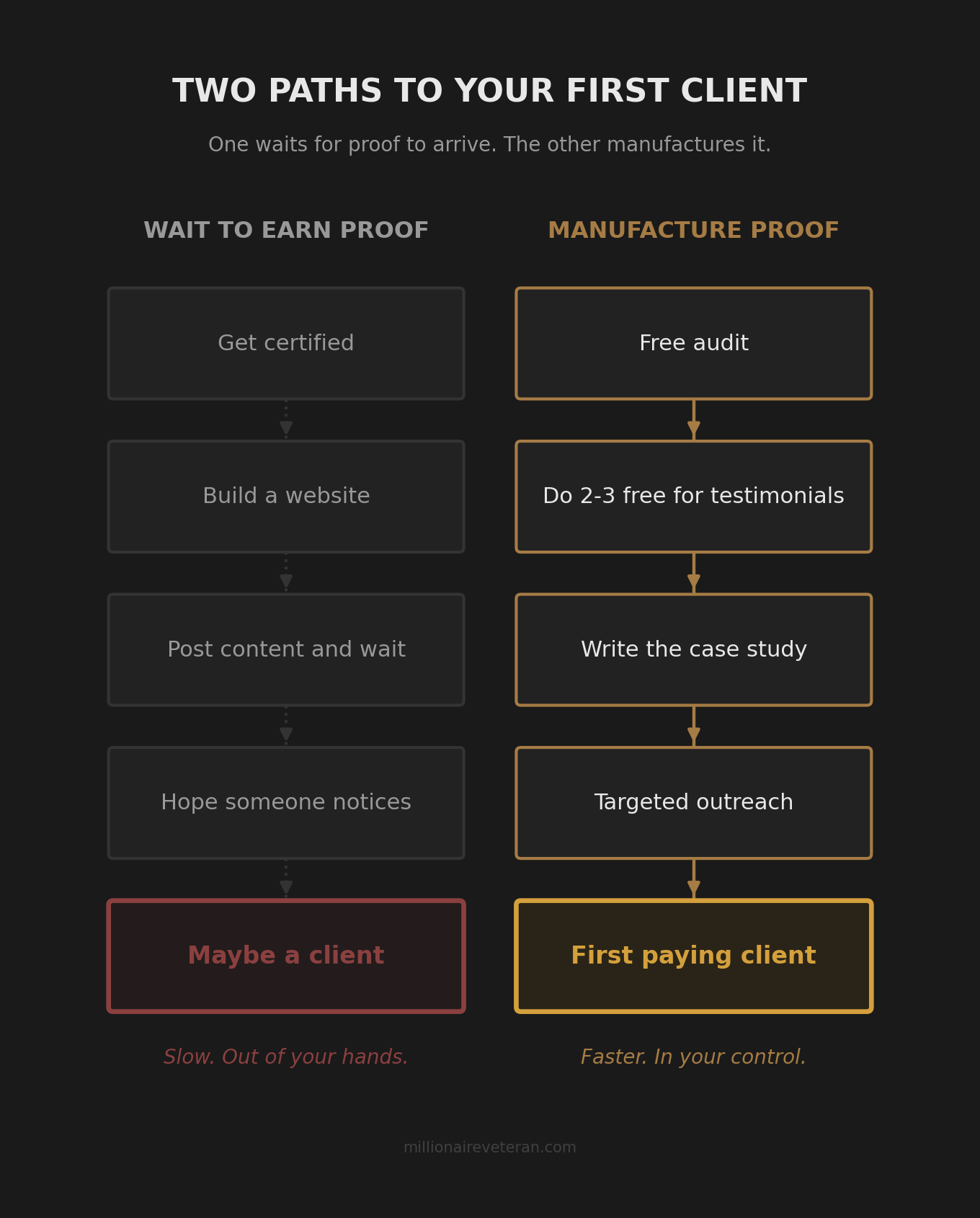
That voice is wrong, but not for the reasons you have been told. The answer is not to wait until you feel qualified. The fastest path to client one is a free, zero-obligation audit, delivered to a real business, that proves you can do the work before anyone has to pay to find out. The track record you are missing is something you build on purpose, not something you wait around to be granted.
This is the move most “get clients” advice skips, because most of it assumes you already have proof to point to. This article is for the moment before you have any. Three things get you to your first paying client: a free audit that removes the buyer’s risk, a small number of free or near-free jobs that buy you testimonials, and a niche narrow enough that the right person reads your offer and thinks “that is me.”
Why “No Testimonials” Feels Fatal and Isn’t
Here is what a small business owner is actually thinking when they consider hiring you. They are not asking whether you are certified. They are asking a simpler, more selfish question, the one that sits underneath every hiring decision a small business owner makes. It is some version of this: will this work, and will I regret it?
Credentials are one way to answer that question. They are the slow way. A certification says “a third party checked my knowledge.” A five-year client list says “other people took this risk and it worked out.” Both are forms of borrowed trust, and both take a long time to build.
There is a faster way to answer the same question. Lower the buyer’s risk to almost nothing. If hiring you costs them no money and almost no time, the question changes from “is this person worth the risk?” to “what do I have to lose?” The honest answer is nothing, and that is the door you walk through.
This is the principle the rest of this article runs on: founders buy outcomes, not credentials. They want their books clean, their posts getting seen, their leads stopping their slow leak out the bottom of the bucket. Show them an outcome on their own business and the missing résumé stops mattering. Most new service providers spend months trying to look more credible when they could spend that time showing a prospect a fixed problem on their own books instead.
The Free Audit: How to Get Clients for a New Business Without a Track Record
The free, zero-obligation audit is the single most reliable way to land client one, so it is worth being precise about what it is and how to run it.
An audit is a small, complete piece of real work, done on the prospect’s actual business, delivered for free, with no obligation to buy anything. It is not a sales call. It is not a free consultation where you talk in generalities and then pitch. It is a deliverable they can hold.
What it looks like depends on your function:
- If you do bookkeeping, you offer a free review of the last month of their transactions. You pull a sample, flag what is miscategorized, and show them one thing that is costing them clarity at tax time. This is the same function behind building a bookkeeping practice, pointed at proving competence instead of billing for it.
- If you do social media management, you offer a free teardown of their last ten posts. Three specific fixes, named, with the reasoning. Not “post more.” Something they can act on tomorrow.
- If you do operations or tech setup, you audit how leads come in. You map their intake or scheduling and show them exactly where prospects fall through the cracks and never get a follow-up.
The audit does two jobs at once. It proves you can do the work, on their business, where it counts. And it gives the prospect a reason to say yes that has nothing to do with how long you have been in business. You are not asking them to trust your past. You are showing them your present.
One rule keeps this clean: the audit has to be genuinely useful even if they never hire you. If it is a thinly disguised pitch, they feel it, and the trust you were building evaporates. Give them something real. The ones who see real value are the ones who ask what working together would look like.
Do a Few Free, On Purpose
The audit gets you in the room. To get the testimonials and case studies that make every future client easier, you do a few jobs free or near-free, deliberately, as a one-time investment.
Pick two or three prospects. Offer to do the actual work, free or at a steep discount, in exchange for two specific things: a written testimonial when you deliver, and permission to write up the result as a case study. Say it plainly so nobody is confused about the deal. You do the work. They give you the words and the permission. Both sides know the terms going in, and there is a defined end so it does not turn into unpaid labor with no finish line.
This is not working for exposure, and it is not charity. It is buying inventory you cannot get any other way.
You do not earn proof, you manufacture it.
Three free jobs gives you three testimonials and three case studies. That is more concrete proof than most established competitors bother to put on their websites, and you built it on purpose in a matter of weeks instead of waiting years for it to accumulate.
Be selective about who you do this for. You want prospects who are organized enough to actually give you the testimonial, and whose business is close to the kind of client you want to be paid by later. A free job for a business you would never want as a paying client teaches you nothing and gives you a case study that points at the wrong market.
When you deliver, ask for the testimonial the same day, while the result is fresh. Make it easy. Tell them what would help most: a specific sentence about what changed, not a vague “great to work with.” A testimonial that names the result a prospect can picture on their own business does more work than a general compliment ever will.
Niche Down So the Buyer Sees Themselves
“I do bookkeeping for small businesses” is invisible. “I do bookkeeping for solo electricians and plumbers” is hireable.
The difference is recognition. The electrician reads the second one and thinks “she works with people like me, she probably already understands how my jobs and invoices work.” You did not shrink your market. You sharpened it, so the right person sees themselves in your offer instead of skimming past one more generalist.
New service providers resist this because narrowing feels like turning down money. It does the opposite early on. A narrow niche makes you easier to recommend, easier to remember, and easier to say yes to, because you are speaking the buyer’s language instead of speaking to everyone and landing with no one.
Pick a first niche you can already speak to. Often it comes from prior work, from a trade you understand, or from the community you came up in. Service members and spouses frequently have a natural niche hiding in plain sight: an industry they worked in before, a specialty they ran in uniform, a community they are already trusted inside. Start where you already have language and credibility, even a little.
This is the EM thesis in practice. The function is constant. The niche is a choice, and you are allowed to change it. If electricians turn out to be the wrong fit, you carry the same bookkeeping skill to a different niche next quarter. The skill travels. The label is just a door.
Where the First Clients Actually Come From
With a free audit to offer and a niche to aim it at, the question becomes where to point it. Three paths, in order.
Warm network first. The first client almost always comes from two degrees of separation. Former coworkers, people from a unit or family-readiness network, a community you already belong to. You are not asking them to hire you. You are telling them what you do now and who you help, and asking if they know anyone who fits. Someone in your network knows a small business owner who is drowning in exactly the thing you fixed in your free audit.
The free audit as outreach. Make a list of about ten small businesses in your niche. Reach out leading with the teardown, not the pitch. “I work with electricians on their books, I put together a short free review of one month of yours, want me to send it?” is a different message than “I am a bookkeeper, are you hiring?” One offers value with no strings. The other asks for a job. Lead with the first one every time.
Targeted direct outreach. Once you have a case study, cold outreach starts working. Short message, one specific service, one specific offer to review their thing for free. The close rate is low and that is fine. The clients who come through this path tend to be higher quality because they responded to substance, not pressure. This is also where starting from zero stops feeling like a disadvantage, because the free audit costs you nothing but time, and time is the one thing you can spend before you have revenue.
The order matters. Warm network and free audits carry you to the first case study. Cold outreach scales after you have something real to point to.
Turning a Free Job Into a Paying Client
The step most people skip is the simplest one. At the end of a free audit or a free job, you make an offer. Out loud. In writing.
It sounds like this: “Here is what I found. Here is what I would fix on an ongoing basis. Here is what that costs per month.” Then you name a real number. For most entry-level service work that lands somewhere in the $250 to $500 per month range depending on the function and the size of the client. Do not flinch at the number, and do not undersell to feel safe. A bookkeeper who charges $50 a month gets treated like a $50 vendor and resented when they raise it. Price like the work is worth doing.
Some free jobs convert to paying clients. Some do not. Both outcomes are fine, and here is why. The prospect who says no still gave you a testimonial and a case study. The free work is never wasted, because the proof you manufactured belongs to you regardless of whether that specific person becomes a client. Every free audit either turns into revenue or turns into ammunition for the next pitch.
Make the offer once, clearly, then stop. No follow-up sequence designed to wear them down. You delivered value, you stated the terms, and the decision is theirs to make on their own timeline. A buyer who hires you because you gave them room to decide tends to be a steadier client than one you cornered into a yes.
From “Sell It” to a Business
Everything in this article is the third step of a model. Learn It, Use It, Sell It. You Learned the function. You Used it on your own work and on a few free jobs to build proof. Landing clients is the Sell It step, where the skill finally turns into income. The open question that decides whether this is worth your time is simple: does landing a client reset the whole scramble with every new one, or does the work you did to win client one compound into client two and three?
The reason this matters is that the playbook does not reset every time. The free audit, the do-a-few-free loop, the niche-down move, and the make-the-offer step work the same way whether you chose bookkeeping, social media management, or operations. They are not bookkeeping tactics or marketing tactics. They are how any of the three business functions becomes a paying client list.
If you want the full loop, the Learn It, Use It, Sell It framework lays out how a function becomes a durable business instead of a one-time scramble for client one. One additional income stream changes the math on everything.
Get Your First Clients Alongside People Doing the Same Thing
The free Millionaire Veteran community is where service members and spouses run this exact playbook in the open. Inside it, the Cash Injection Playbook is a living resource members keep current: the free-audit scripts people are sending, the outreach messages getting replies, the niches members are working right now. It is not a static download. It grows as members test what works and report back.
The community also runs the full Compass Method, so when those first clients start paying, the new income routes somewhere on purpose instead of disappearing into the pile. Getting clients is the hard part. Keeping the money you earn is the part most people never set up.
It is free to join, and you can start with the exact moves in this article.

About the Author
Joshua Breaux
Retired U.S. Marine
Financial Management Analyst
BS & MBA in Analytics
His family runs on the same systems he teaches here.
This content is educational and does not constitute personalized financial advice. Millionaire Veteran is not affiliated with the Thrift Savings Plan, FRTIB, or the U.S. Government. Past performance does not guarantee future results.