
You do not need to start a business today.
If you just read the previous article and felt the pull to go register an LLC, slow down. The three functions are real. The B2B opportunity is real. But none of it works without the skill underneath, and the skill comes first.
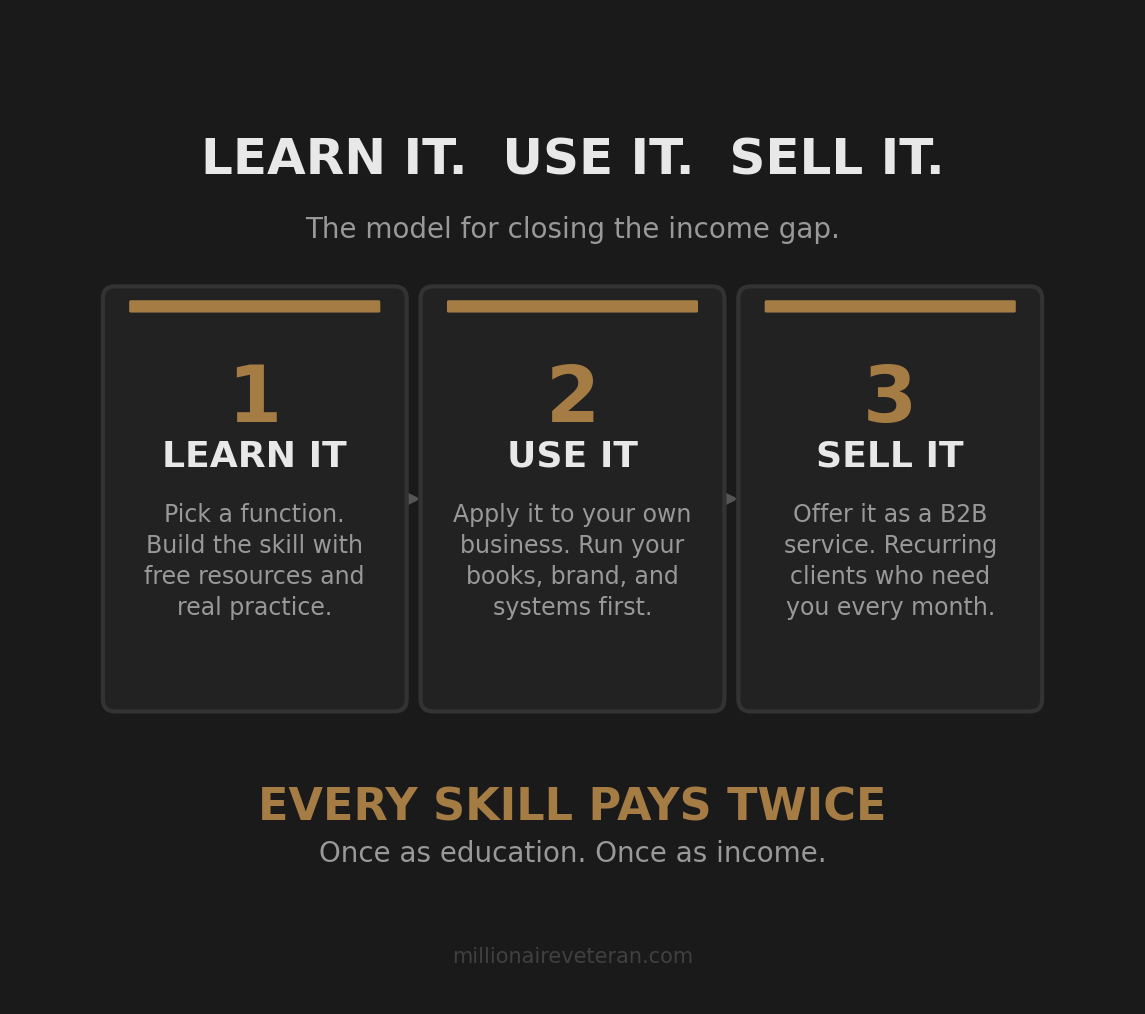
The pattern is simple. Learn a real business function. Use it for your own business. Sell it as a service to other businesses that need it. Every skill pays twice: once as education, once as income. That is the model. This article breaks down what each step looks like, how the three functions turn into real services, and how to pick the path that fits where you are starting from.
Skill Stacking Comes First
The gurus skip this part. They go straight from “sign up” to “land your first client in 30 days.” That is how people end up selling services they cannot deliver and burning the client relationship before it starts.
The actual sequence is slower and it works.
Pick your function. If the last article did its job, you already know which one you lean toward. Operations, Accounting, or Marketing. Maybe you recognized yourself in two of them. That is fine. Pick the one that pulls the most and start there.
Then learn it. Not from a $997 course. From free resources that already exist. The Millionaire Veteran community has curated starting points for each function: where to begin, what tools to learn first, what the foundational skills actually are. This is not a curriculum. It is a direction. The learning itself happens through practice, repetition, and building things that are ugly at first and get better over time.
The goal of this phase is not to become an expert. It is to get competent enough to be useful. You are stacking a skill on top of the natural ability you already have. The operations mind who learns to set up a CRM. The numbers mind who learns QuickBooks. The creative mind who learns Canva and a social media scheduler. The tool is learnable. The instinct is already there.
Use It for Your Own Thing
Before you sell anything to anyone, apply the skill to your own business.
If you are learning accounting, run your own books clean from day one. Know your numbers. Price correctly. Understand your margins. When your own financial house is in order, every business decision gets easier.
If you are learning marketing, build your own brand. Drive traffic to your own business. Create content that brings people to you instead of you chasing them. Every piece of marketing skill you develop gets applied to your own thing first.
If you are learning operations, run your own business efficiently. Automate the things that eat your time. Set up scheduling, invoicing, and client communication systems once and let them run. This is what makes a one-person operation sustainable instead of exhausting.
Sell It to the Businesses That Need It
This is where the B2B opportunity from the previous article becomes income.
You learned the skill. You used it on yourself. Now there are businesses near you, and increasingly anywhere with an internet connection, that need someone doing exactly what you just learned.
The accounting play: small businesses need their books managed. Monthly recurring work. Categorize transactions, reconcile accounts, generate reports, keep the books clean. That is the entry point and it is valuable on its own. Businesses pay for it because they either do not know how or do not have time. As you gain experience, the work escalates into advisory: helping the owner understand their margins, restructure pricing, make decisions based on actual data instead of gut feeling. Remember the photographer from the last article charging $50 a session? A bookkeeper can show the real cost per shoot. An advisor can restructure the pricing tiers and build a service menu that actually makes money. Those are two levels of the same function, and the second one commands significantly higher rates because you are not just recording numbers, you are telling the owner what the numbers mean and what to do about them.
The marketing play: small businesses need to be seen. Social media management, content creation, brand identity work, paid ad setup and management. The creative side and the analytical side both have clients, and the strongest operators cover both. A content creator who understands brand voice and visual identity brings a different value than someone who can read ad performance data, test variations, and optimize spend. Most small businesses need both and have neither. A marketer who can create the content AND tell you which pieces are actually driving revenue is covering ground that agencies charge thousands a month for.
The operations play: small businesses are drowning in manual processes. Scheduling done through text messages. Invoicing done in spreadsheets or not at all. Client onboarding that is different every time. An operations person who can walk into that chaos, audit how the owner spends their time, and build systems that eliminate hours of weekly manual work is solving a problem most owners do not even realize they have. They know they are busy. They do not know that half of what keeps them busy could be automated by someone who knows how to set up the tools.
The price ranges vary by function, experience, and market. A few hundred a month per client is a reasonable starting point for most B2B services. As your skills develop and you move from basic execution into advisory or strategy work, those rates grow. The bookkeeper who started at a few hundred a month doing data entry is now charging more because they are advising on pricing and margins. The marketer who started managing one social account is now running full campaigns across multiple platforms. The work grows with you.
Two or three recurring clients starts closing the gap from the first article in this series. You do not need twenty clients. You need a handful of good ones who need you every month and whose businesses get better because you are involved.
The Partnership Model
The bookkeeper needs marketing. Great with numbers but no idea how to build an online presence, create content, or run an ad.
The marketer needs bookkeeping. Landing clients and creating content but invoicing is a mess, pricing is based on vibes, and there is no idea whether the business is actually profitable.
The operations person needs both. Builds incredible systems but has no visibility and no financial tracking.
These three people do not need to compete. They need to collaborate.
Think about what happens when they trade services instead of paying for them. The bookkeeper manages the marketer’s books. In exchange, the marketer builds the bookkeeper’s social presence. The operations person sets up scheduling and invoicing systems for both of them. In exchange, one handles the books and the other builds the online presence. Nobody spent money. Everyone gained a real client, real work for their portfolio, and a real review they can show the next prospect.
That is not theoretical. It is how professional services have worked for decades. Lawyers refer to accountants. Accountants refer to financial planners. Contractors refer to electricians. Real estate agents refer to inspectors and lenders. The referral network is the oldest business development model that exists, and it works because each person in the network makes the others more valuable. Nobody built a professional practice entirely alone. Nobody needs to.
Now scale it. The bookkeeper’s paying client mentions they need help with social media. Refer the marketer. The marketer’s client is growing and needs someone to clean up their books. Refer the bookkeeper. The operations person’s client needs both. Refer both. Every good referral strengthens the network. Every delivered project builds trust that generates the next project.
The community is where those partnerships form naturally. People learning the same functions, in the same situation, looking for exactly this type of collaboration. Your first client might be someone you met in the community who needs the function you are building. Their first client might be you. That is not a hypothetical. It is how professional networks have always started: people with complementary skills finding each other and building something together that none of them could build alone.
Three Paths, One Foundation
Not everyone follows the full Learn, Use, Sell sequence the same way. Where you start depends on where you are.
Serve First. You do not have a business idea and you do not need one. Skip the B2C delivery layer entirely. Pick one function. Learn it. Sell it as a B2B service. Bookkeeping for small businesses. Social media management. Tech stack setup. You do not need your own brand to build someone else’s. You do not need your own product to manage someone else’s books. One function, a handful of clients, and the gap from the first article starts closing. This is the fastest path to income and the most realistic for someone with limited time and a full plate at home.
Build and Serve. You already have a delivery business or you want to start one. Photography, fitness coaching, baking, whatever it is. You learn the constant functions to run your own thing well, and you sell one of those same skills as a B2B service on the side for additional income while you grow. The B2B income funds the delivery business while it finds its footing.
Build It Right. You already have a business and you are not interested in selling services to other businesses. The three functions still apply. Learning marketing, accounting, and operations means your existing business runs on a real foundation instead of guesswork. You are choosing to invest everything into your own operation. That is a legitimate path and the framework supports it.
All three paths build the same skills. The difference is how you apply them. For military families, the B2B paths have a particular advantage: the work is digital, location-independent, and asynchronous. Your clients do not care where you are stationed. The work gets done the same way from anywhere. A spouse building a bookkeeping practice and a service member managing social media accounts on the side are both running B2B services that survive every move, every deployment, and every schedule change the military throws at them. The function travels because it was never tied to a location in the first place. That is the structural advantage. The delivery businesses on every base, the photography studios and the bakeries and the lawn care companies, break when life changes. The functions do not break because they were built to be portable from the start.
What This Series Has Been Building Toward
The first article showed you the ceiling. One income source, even a good one, has a mathematical limit.
The second article showed you the guru playbook. The funnels, the fake masterclasses, the patterns they use to sell the dream instead of the skill.
The third article showed you what sits underneath every business that works. Three functions. One framework.
This is the Earn More domain of the Azimuth Framework. The Spend Less series covers the cash flow side. The Invest Smarter series covers where the surplus goes. Earn More closes the gap from the income side. All three domains move together, and now you have the model for the income piece: a skill you build, a service businesses actually need, and partners who make the work better.
Where to Start
The Millionaire Veteran community is where the Earn More framework lives. Free resources for each function to start skill stacking. The Compass Method cash flow system so every new dollar you earn routes to the right place instead of disappearing into lifestyle creep. And the people who are figuring out which function fits, finding partners, and building their first client relationships right alongside you.

About the Author
Joshua Breaux
Retired U.S. Marine
Financial Management Analyst
BS & MBA in Analytics
His family runs on the same systems he teaches here.
This content is educational and does not constitute personalized financial advice. Millionaire Veteran is not affiliated with the Thrift Savings Plan, FRTIB, or the U.S. Government. Past performance does not guarantee future results.