

The previous article asked you to find your stage on the FI spectrum. If you are at Stage 1 or Stage 2, you probably already know what your first instinct is.
Cut spending.
Cancel subscriptions. Stop eating out. Make coffee at home. Tighten the budget. White-knuckle it until the numbers move.
That instinct is not wrong. It is incomplete. And if it is the only lever you pull, the numbers will move for a while, then stop. The gap between where you are and where the compounding targets from the first article in this series sit is almost always wider than what cutting alone can close.
This article is about why that is the case, and what actually works instead.
The Ceiling on Cutting
You can reduce discretionary spending to a point. Dining out, subscriptions, impulse purchases, that second streaming service. All of those are real and cuttable. For most families, the first pass at reducing unnecessary spending frees up $200 to $400 per month. That is meaningful.
Then the cuts start hitting things that are not optional. Rent or mortgage. Car insurance. Groceries for a family of three or four. Childcare if both parents work or one is deployed. SGLI. Phone plans. These have minimums. You can optimize them, shop around, negotiate where possible. But there is a floor below which the household stops functioning, and most military families are closer to that floor than they realize.
The first article in this series showed that maxing all tax-advantaged accounts costs roughly $39,500 per year for a married service member. That is about $3,300 per month. For an E-5 with a family, take-home pay after taxes and deductions runs approximately $3,600 to $3,900 per month depending on dependency status, plus BAH. If essential expenses consume $3,200 of that, discretionary spending is $600. Even cutting every dollar of it, every restaurant meal, every subscription, every impulse buy at the exchange, leaves you $2,700 short of the full contribution target.
That is the structural reality. The gap between $600 of cuttable spending and $3,300 of contribution capacity is $2,700 per month. Discipline cannot close a $2,700 gap when the total discretionary budget is $600. The constraint is arithmetic, not willpower.
This does not mean cutting is pointless. That $600 matters. Routed correctly, it is the seed money that funds the first milestone and starts the compounding clock. But treating it as the entire solution sets up a failure that feels personal when it is actually structural. You did not fail to budget hard enough. The budget was never big enough to carry the full load alone.
The Trap of Earning More Without a System
The obvious response to “cutting is not enough” is “then earn more.” Side income, a spouse’s job, a promotion, a reenlistment bonus. More money coming in should close the gap.
It should. Often it does not.
An E-4 making $2,800 per month has $200 left over after bills. That same person gets promoted to E-6 over four years, and now makes $3,600 per month. The raise was $800. The amount left over at the end of the month is still $200. Where did the other $600 go?
It went where unrouted money always goes. A nicer apartment off base. A better phone. Eating out a few more times per month. None of it felt extravagant. None of it was planned. It just happened, one small upgrade at a time, until the new income matched the new spending exactly.
This is not a discipline problem. It is a routing problem. When money arrives without a destination, it finds one on its own. The default destination is lifestyle expansion. Spending is frictionless. Saving requires deliberate action. And the checking account balance lies, because it shows money that is already committed to rent, insurance, and every autopay that has not drafted yet.
The same pattern plays out with bonuses, tax refunds, and reenlistment payouts. A $15,000 reenlistment bonus hits the account. Within six weeks, it is gone. Not to anything reckless. A couch that was overdue. Catching up on a credit card. A trip home to see family. All reasonable. All unplanned. The lump sum arrived without a routing plan, and the household absorbed it the way a sponge absorbs water: evenly and completely.
An extra $500 per month from a spouse’s remote job does the same thing if there is no system to catch it on arrival. It enters the checking account, mixes with everything else, and by the 14th it is gone. The household income went up. The contribution rate stayed flat.
The Spend Less domain explains why money disappears. The Compass Method separates money by purpose at the bank account level so every dollar has a destination before it can be spent. When income increases, the same system catches the new money and distributes it the same way.
Why Investing Without Cash Flow Is Backwards
Some people skip straight to investing. They read about compounding, set their TSP contribution to 15%, and feel like they are doing the right thing. On paper, they are.
In practice, their emergency fund is empty. When the transmission fails, they pull from savings or put it on a credit card. The credit card balance grows at 22% while the TSP grows at 7%. The numbers are working against each other.
Contributing to retirement while carrying high-interest debt is not a net positive in most scenarios. Every dollar going to TSP at 7% while a credit card charges 22% on a carried balance is losing 15 cents per dollar. The compounding engine from the first article only works when there is not a competing engine running in reverse.
The other version of this problem is the raided emergency fund. You build it to $3,000. Then the washing machine breaks. Then the car needs tires. Then a family visit runs over budget. By the third quarter, the emergency fund is back to zero and you are rebuilding it for the second time. Meanwhile, TSP contributions continue into an account you cannot touch until 59 and a half, while the household has no buffer for the next surprise.
The order matters. Cash flow stability comes before aggressive investing. Debt elimination comes before maxing retirement accounts. A funded emergency account comes before increasing TSP contributions beyond the match. Each of these is a gate. Clearing one makes the next one possible. Skipping one makes the next one fragile.
There is a version of this that is even more common: the person who is doing all three at once, badly. Contributing 10% to TSP, carrying $8,000 in credit card debt, no emergency fund, and no cash flow visibility. Every paycheck gets split between competing priorities with no sequencing logic. TSP grows at 7%. The credit card grows at 22%. The emergency fund gets raided every quarter. The net effect is a household running hard and going nowhere, because the three levers are fighting each other instead of compounding.
How the Three Compound Each Other
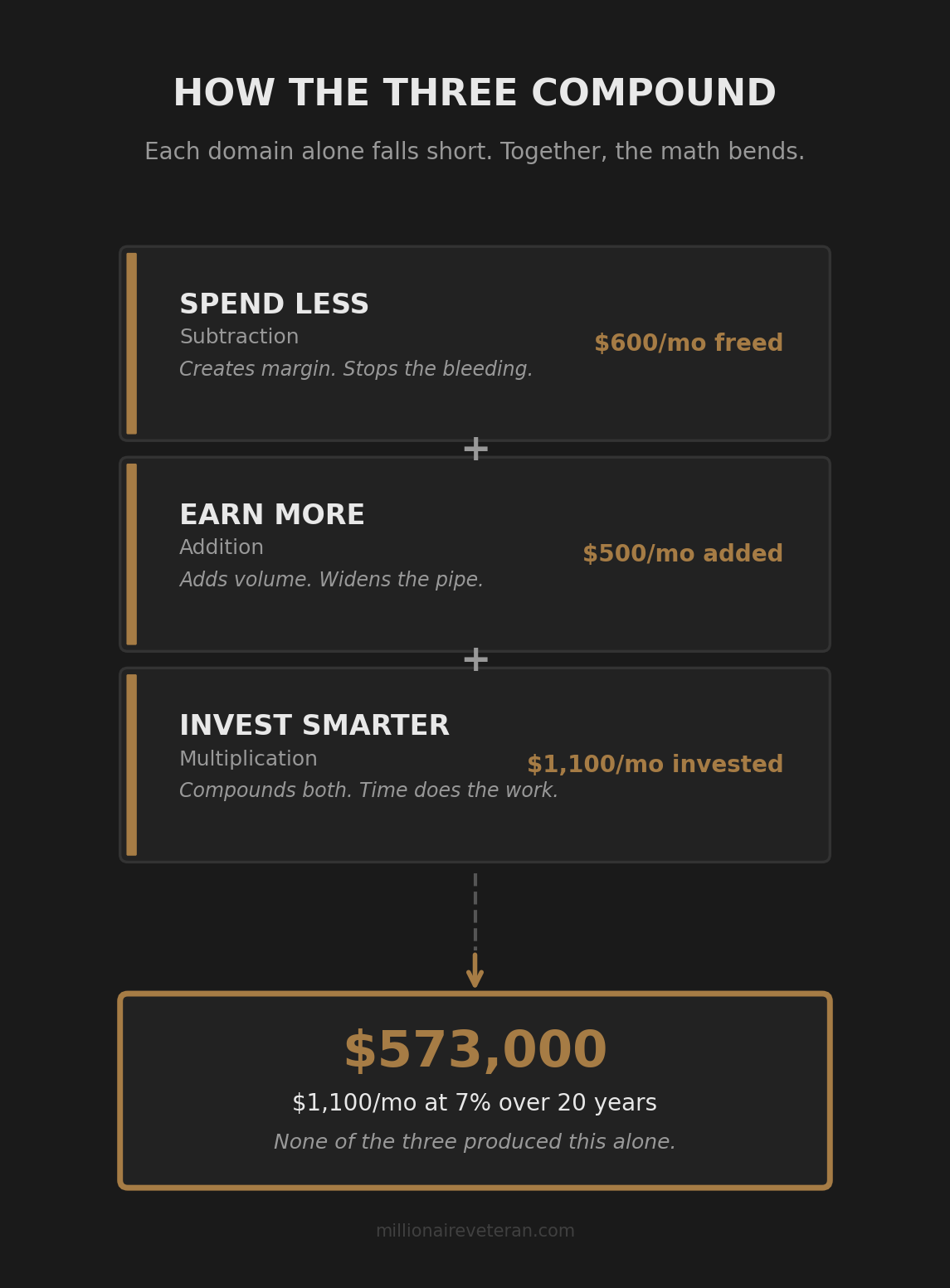
Cash flow management creates margin. When every dollar has a destination on arrival, the household stops bleeding money to lifestyle drift. The $600 of discretionary spending from the cutting example becomes a real, visible number that can be deliberately directed. That margin becomes the fuel for everything else.
Income growth adds volume. A spouse who picks up a remote client at $500 per month did not just add $500 to the household. If that $500 deposits into the Income account and gets distributed through the same Payday Ritual as every other deposit, it goes directly to the active milestone instead of disappearing into the checking account. The cash flow system catches income that would otherwise be absorbed.
Investing compounds both. The $600 freed from cash flow plus $500 from additional income is $1,100 per month directed to retirement accounts. At 7% over 20 years, $1,100 per month produces approximately $573,000. Of that, $264,000 is contributions. The other $309,000 is compounding. The three levers together produced a result that none of them could have produced alone.
That integration is what the Azimuth Framework describes. Three domains. Spend Less, Earn More, Invest Smarter. Sequenced in that order because each one depends on the one before it. Investing what is leaking produces no net result. Growing what you cannot see is guessing dressed up as strategy. And earning more without a routing system just raises the floor alongside the ceiling.
The military pay structure gives the cash flow system something most civilian households do not have: a predictable rhythm. The predictable pay schedule means the cash flow system can be calibrated precisely. BAH covers housing. BRS matching provides an immediate return on TSP contributions. The pension reduces the portfolio target at the end of the road. When all three domains are running inside that structure, the compounding math from the first article starts producing results faster than it would for a civilian household with the same income but none of the structural support.
A civilian earning $60,000 with a 3% employer match and no pension needs to build a larger portfolio, pay more for healthcare in retirement, and manage an unpredictable career trajectory. A military family earning $60,000 with a 5% BRS match, a future pension, and TRICARE has a shorter distance to cover. The three domains close a smaller gap, and the structural floor underneath means each dollar of progress covers more ground.
The Sequence
The order is deliberate.
Spend Less comes first. Stop the bleeding. Get a cash flow system running so every dollar routes to a purpose. This is subtraction: removing the waste, the drift, the invisible spending that eats income before it reaches anything productive. The Spend Less series covers this in depth.
Earn More runs in parallel. Base pay has a ceiling. If the gap between your take-home and the full contribution targets is wider than what you can cut, additional income is the lever that widens the pipe. The Earn More series covers where the ceiling sits and what to do about it. Earn More does not wait for Spend Less to finish. It runs alongside it from the beginning.
Invest Smarter runs always. At minimum, capture the TSP match from day one. That is an immediate positive return before the market does anything. As the other two levers free up cash flow and add income, increase contributions toward the full tax-advantaged capacity. The Invest Smarter series covers how BRS changed the investing landscape for military families.
The sequence is not “finish one, then start the next.” It is “prioritize in this order, run all three as capacity allows, and increase each one as the others create room.” A first-termer capturing the 5% match while getting their cash flow system set up is running two domains at once. A household where the spouse starts a remote side income while the service member pays down a credit card balance is running all three. The sequence defines priority, not exclusivity. Everything runs. The question is what gets the next available dollar.
What Comes Next
You know where you are on the spectrum. You know that no single domain closes the gap alone. You know the sequence and why it matters.
The remaining question is concrete: what do you do first, second, and third? And how do you know when you are ready for the next step? The next article in this series lays out six milestones between where you are and full financial independence. Each milestone has a specific gate condition. You either meet it or you do not. There is no ambiguity about whether you are ready to advance. The milestones turn the framework into a checklist.
Get the Personalized Sequence
The three domains make sense as a concept. Applying them to your household requires your actual numbers.
The free Millionaire Veteran community includes the Diagnostic Review, which maps your income, debt, contributions, and cash flow to the roadmap. From there, the system walks you through what to address first based on where you actually are, not where a blog post assumes you might be.

About the Author
Joshua Breaux
Retired U.S. Marine
Financial Management Analyst
BS & MBA in Analytics
His family runs on the same systems he teaches here.
This content is educational and does not constitute personalized financial advice. Millionaire Veteran is not affiliated with the Thrift Savings Plan, FRTIB, or the U.S. Government. Past performance does not guarantee future results.